

Schema Markup in SEO helps search engines understand your content, improve rich results, and enhance your website’s visibility in search..Schema markup is a set of tags (called microdata or structured data) that you can include within your web page’s code to provide search engines with more information about its content, context, and significance.
Search engines can better comprehend the subtleties of your content, such as the connections between various data points and their applicability to search queries, thanks to this extra layer of information. As a result, schema can enhance how your pages are indexed and displayed in search results, making them more likely to stand out and attract relevant traffic.
What Is Schema Markup?
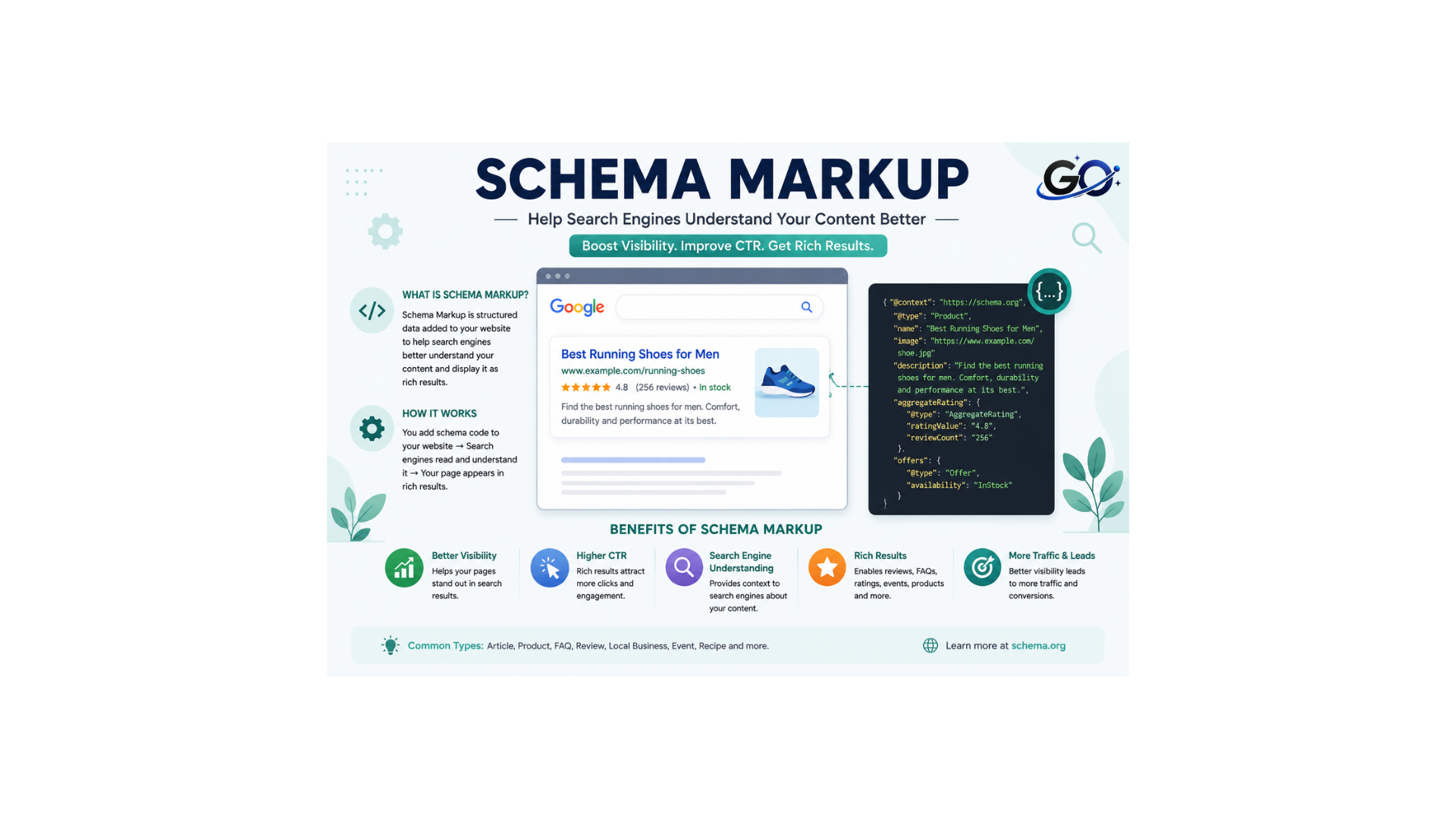
Schema markup is structured data that describes information on a webpage using the Schema.org vocabulary. It provides search engines with more context regarding the meaning of various content items.
A webpage might, for instance, list a product’s name, price, availability, brand, and rating. Although structured data offers a standardised method of identifying each piece, a search engine can still read this information from the visible page.
Similarly, an article can use structured data to identify its headline, author, image, and publication date.
How Does Schema Markup Work?
When crawlers examine the HTML of your website, they find a script that uses tags from Schema.org’s standardised language to explicitly describe certain parts of your material in a way that search engines can comprehend. This is how schema markup works.
Schema markup, for instance, can clearly inform search engines that a certain product costs €299.” Therefore, they don’t need to guess what $299 means.
Search engines can more precisely classify your content and identify which rich results it can qualify for thanks to the explicit communication provided by schema markup.
Why Is Schema Markup Important for SEO?
Schema markup plays a crucial role in how search engines perceive and rank your web pages. By providing additional information about your web page, such as its title, description, and images, schema markup helps search engines understand the meaning and context of your content.
Schema Markup in SEO helps search engines better understand the content and context of a webpage, which may improve its visibility in search engine results pages (SERPs). It can also make eligible pages appear with rich results that provide users with more useful and visually appealing information. As a result, schema markup may increase click-through rates (CTR) and help attract more relevant traffic to your website.
Types of Schema Markup
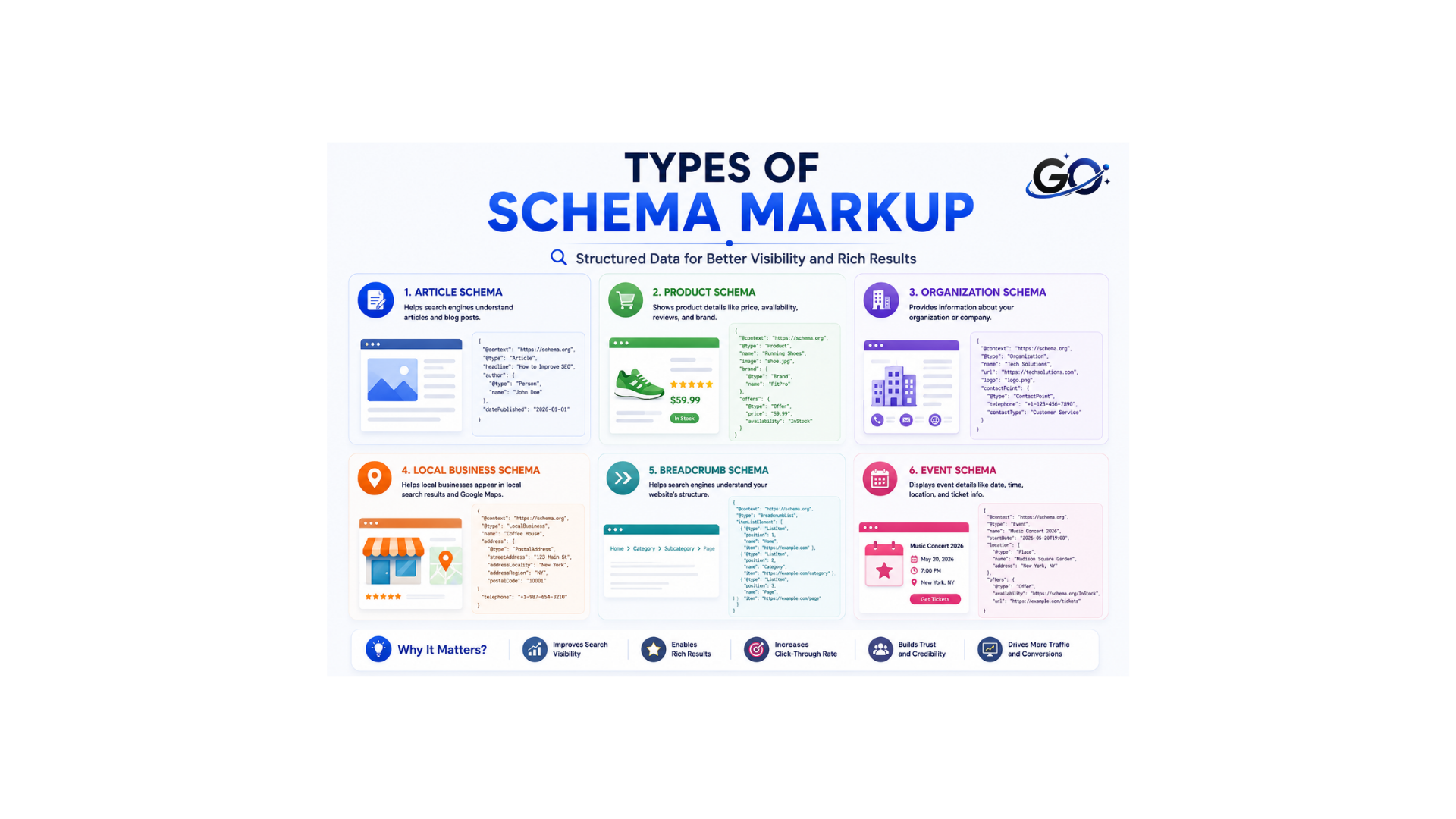
There are many Schema.org types, and the appropriate choice depends on the content and purpose of a webpage.
Article Schema
In addition to making your pages eligible for a rich snippet in Google Search and Google News, article markup aids search engines in comprehending news pieces, blog posts, and sports stories.
The appearance of article titles, author names, and publication dates in search results can be affected by the use of article markup.
Product Schema
One of the two forms of product schema markup is product snippet markup, which is intended to give search engines additional product information for pages like product review pages when visitors are unable to make a purchase.
This kind of markup enables search engines to show details like these in search results:
Advantages and disadvantages Important benefits and drawbacks of the product (accessible exclusively for editorial product review sites)
For journalistic websites, affiliate marketers, and e-commerce platforms that display products but do not sell them directly, product snippet markup is very useful.
Organization Schema
Search engines can learn more about your company, including its name, logo, address, and contact information, thanks to organization schema markup.
If your company has a knowledge panel in Google search results, organization schema can also affect how your organization’s details show up. This can include information about retailers, such as contact details and return policies.
Local Business Schema
Key details about a physical business, including as its address, phone number, and operating hours, are provided to search engines by local business markup.
Local business markup is advantageous for physical stores, eateries, service providers, and other companies looking to draw in local clients. It assists in verifying the accuracy of your company’s information, which supports how Google presents your company in local search and maps results. .
Breadcrumb Schema
Breadcrumb markup, such as “Home > Laptops > Gaming laptops,” indicates to search engines where a page is located in the structure of your website.
This markup is used by Google to create the breadcrumb trail that appears in search results, allowing people to see the location of the page on your website before they click. Google does not guarantee that the feature will show up, just like with other structured data.
Event Schema
Event schema uses rich results with date, time, place, ticket information, and calendar integration options to drive attendance for conferences, webinars, concerts, and any other scheduled event. Virtual, physical, and hybrid events are supported by the markup; this progress was expedited in 2020 and is still crucial in the hybrid work environment of 2025.
Schema Markup and Rich Results
One important reason website owners use Schema Markup in SEO is to make eligible pages capable of appearing with enhanced search features.
Rich results can display additional information beyond a standard search result. Depending on the supported feature, this may include product information, ratings, prices, event details, breadcrumbs, or other relevant information.
Adding Schema Markup in SEO does not, however, ensure that enhanced results will show up. Search engines determine a page’s eligibility and the possible presentation of its content.
Does Schema Markup Improve Rankings?
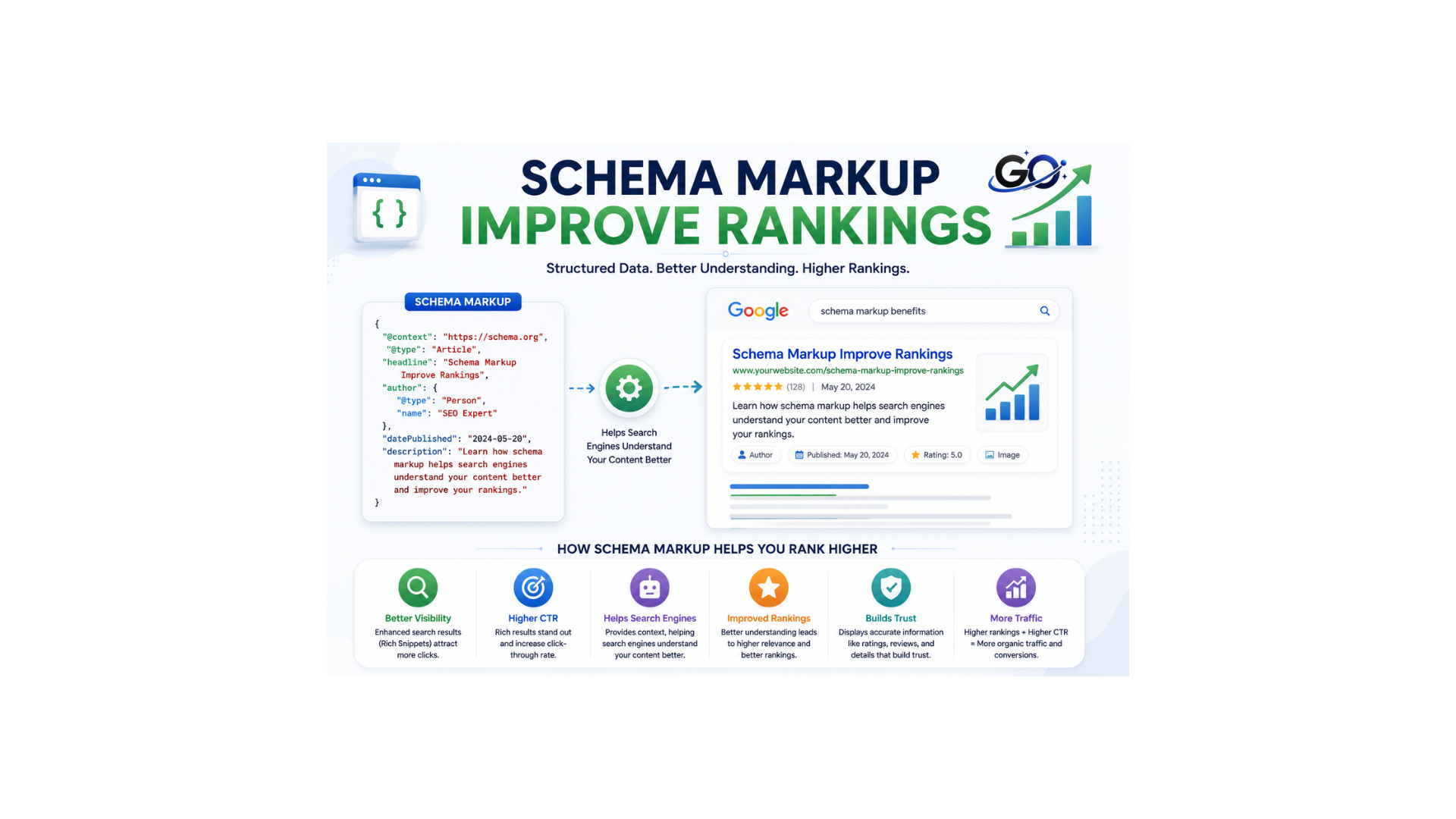
As mentioned earlier, improving Google’s comprehension of the content on your pages raises your chances of ranking for more relevant phrases. When search engines are able to understand the content of your pages, they are more likely to consider it a relevant result for particular searches, increasing your visibility in search engine result pages (SERPs). After implementing schemas on their websites, our businesses’ rankings have significantly increased; we’ve seen an average increase of two to three spots in the Google search results.
How to Test Schema Markup
When you and your development team implement a schema on your website, there are a few things to consider.
- Appropriate Use of Schema Types: The web team’s addition of markup that highlights content that differs from what is on the site is one of the most frequent structured data errors we observe. Similarly, be careful not to add the incorrect kind of schema to the incorrect template. Both of these errors lead to the same outcome: a drop in ranks.
- Monitoring and Re-Crawling of Schema:It usually takes two to three weeks for search engines to re-crawl and index the new code after schema markup is implemented. Check the code for possible mistakes right away if, after this time, the schema is still not shown in your search results. A schema audit allows you to perform this at scale.
You can make sure that your structured data successfully improves the SEO performance of your website by following these recommendations and routinely assessing your schema implementation. We’ll look at some more typical problems with structured markup in SEO below.
Best Practices for Schema Markup
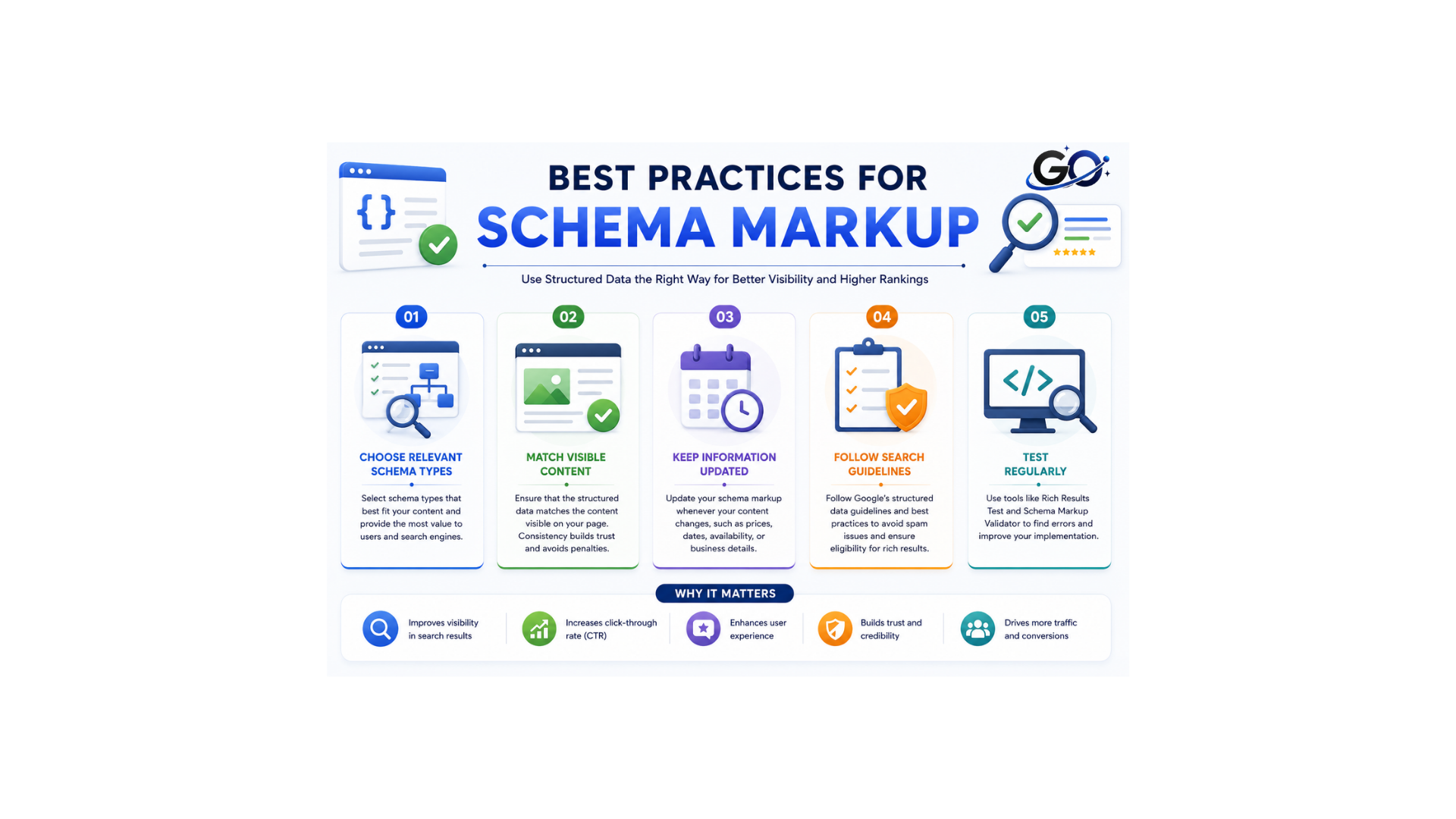
Choose Relevant Schema Types
Choose a schema type that accurately characterises the page. Unrelated structured data should not be used just because it provides a potential search function.
Match Visible Content
The material that consumers can view on the webpage should be appropriately represented by the data in your structured data.
Keep Information Updated
Every time significant information changes, update the structured data. Products, costs, availability, events, and business information are very crucial.
Follow Search Guidelines
Avoid using structured data in deceptive or manipulative ways, and always adhere to the most recent search engine criteria.
Test Regularly
Verify structured data upon implementation and each time a major website modification is performed.
Schema Markup vs. Structured Data
Although the terms “structured data” and “schema markup” are closely related, they are not exactly the same.
The more general idea of arranging information in a machine-readable format is known as structured data. A standardised vocabulary for describing entities and content is offered by Schema.org.
JSON-LD is a format often used to implement structured data. Microdata and RDFa are additional formats.
In simple terms, Schema.org supplies the vocabulary, while JSON-LD can give a mechanism to convey that language through webpage code.
Schema Markup and User Experience
Instead of immediately altering the user experience on a webpage, schema markup mostly interacts with search engines.
On the other hand, improved search results can occasionally be attributed to more organised data. Users may find it easier to comprehend a search result before visiting the website when more information is shown.
This can assist users find pages that are pertinent to their needs and improve the informational value of search results.
However, the actual webpage’s quality is still crucial. Useful information, easy navigation, quick performance, mobile friendliness, and a positive user experience cannot be replaced by schema markup. .
Conclusion
Schema markup is an important structured-data technique that helps search engines understand the meaning and context of webpage content. It can describe articles, products, organizations, local businesses, events, recipes, breadcrumbs, and many other types of information.
Schema markup does not guarantee higher rankings or rich results. However, proper implementation helps search engines understand content and may support eligible rich search features.
FAQs About Schema Markup
What is schema markup in SEO?
In order to aid search engines in comprehending the content, entities, and relationships displayed on a page, structured data known as schema markup is added to webpage code.
Is schema markup a ranking factor?
In general, schema markup is not regarded as a direct ranking factor. Its primary goals are to promote eligibility for specific enhanced search capabilities and better search engine comprehension.
What is the most common schema markup format?
JSON-LD is widely used for structured data. It can be added to webpage code without significantly changing the visible page content.
Does every website need schema markup?
Not every page or website requires the same schema. The nature and purpose of the content determine which structured data is appropriate.
How can I test schema markup?
You can check structured-data reports in Google Search Console. Use Google’s Rich Results Test to verify your markup and eligibility for rich results.