

Dwell time in SEO refers to the duration a visitor spends on a webpage before returning to the search engine results page (SERP). It indicates user engagement and content relevance, impacting rankings as longer dwell times suggest the content effectively meets the user’s search intent.
It can provide useful insight into how visitors interact with search results and webpage content. However, dwell time should not be viewed as a standalone measure of SEO performance.
What Is Dwell Time?

Dwell time is the amount of time visitors spend on a web page before leaving the site.It’s significant since it indicates how long a user will stay on your website.
Dwell time, or the amount of time spent on your website’s different web pages, is one of many performance indicators that can help you determine how well your website is functioning and whether you need to make any adjustments to your content or website. Because dwell time gives you more information about your website’s users, it enhances performance metrics like bounce rate and average session duration.
How Does Dwell Time Work?
Dwell time follows a simple process:
Search → Click a result → Visit webpage → Read or interact → Return to search results
When a user clicks on a search result, the timer essentially begins.
The visit has a brief dwell time if the user rapidly returns to the search results. The dwell time is longer if the user stays on the page for a few minutes before coming back.
A brief dwell time, however, is not always a sign of subpar material. A person may swiftly discover the precise solution they require and depart the page content.
How to calculate dwell time?
As previously said, dwell time is not a metric that can be directly observed in analytics; rather, it can be estimated using related signals. Average engagement time, which indicates how long users actively interact with your page (scrolling, clicking, etc.), is the closest proxy in GA4.
Filter or generate reports for solely organic traffic to obtain an SEO-focused view. Then, examine parameters such as average engagement time, average session duration, bounce rate, and pages per session collectively.
Longer, more engaged sessions indicate longer dwell times, while shorter sessions, high bounce rates, and low engagement among organic users typically indicate shorter dwell times.
Why Does Dwell Time Matter?

Dwell time can help website owners understand how visitors interact with their content.
Provides User Behavior Insights
Context regarding how users react to a webpage after discovering it through a search can be provided by dwell time.A page that maintains visitors’ interest can benefit from more research to determine what makes its material valuable.
Helps Evaluate Content Relevance
The page might not live up to visitors’ expectations if they immediately return to search results.To find potential improvements, website owners might examine the page’s search intent, content quality, title, and structure.
Supports User Experience Improvements
A website’s areas for development can be found by analysing visitor behaviour.A more seamless experience can be produced via improved readability, navigation, page speed, and content organization.
Dwell Time vs. Time on Page
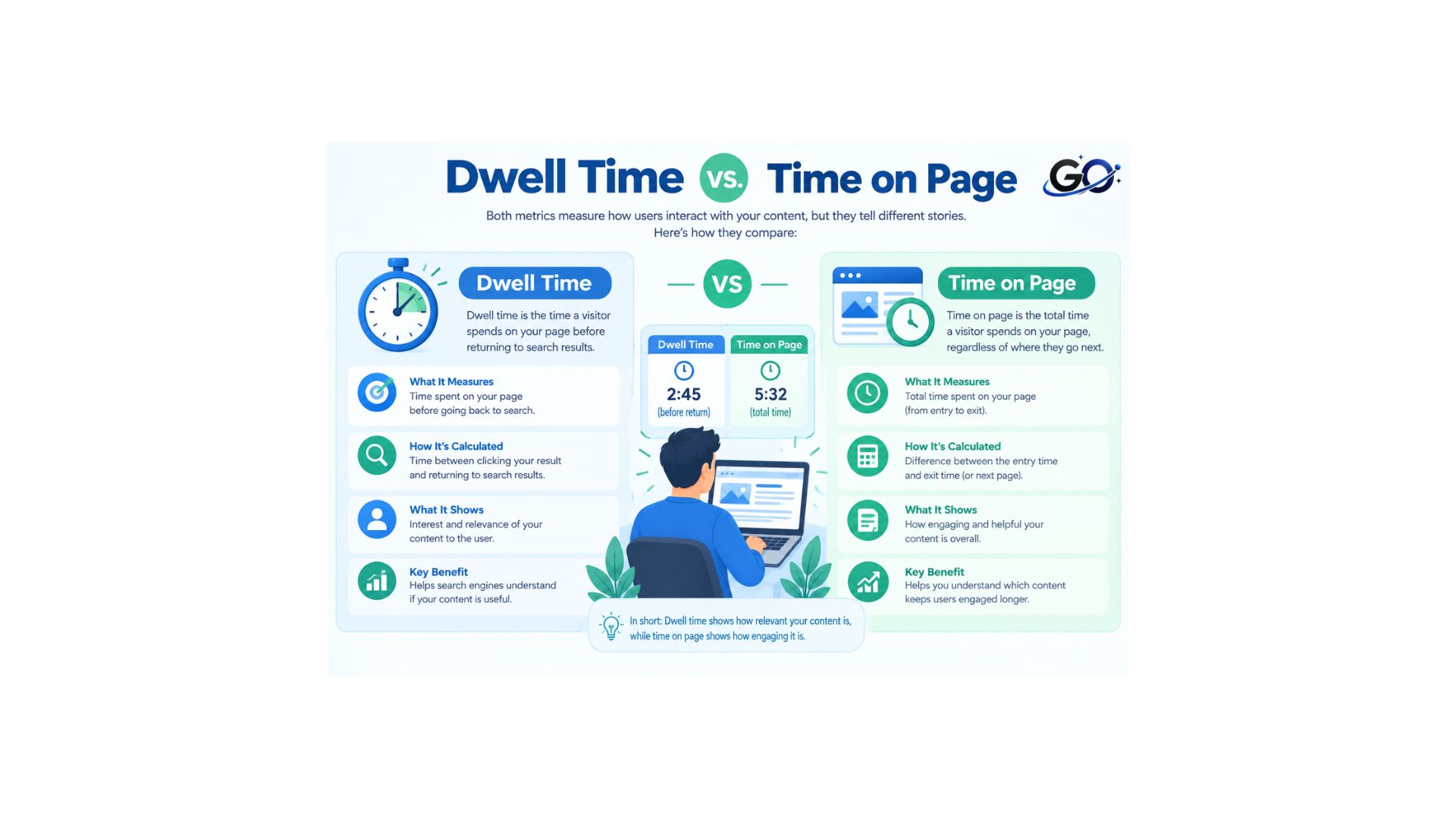
Although they are related ideas, dwell time and time on page are not the same.
Dwell time refers specifically to the time between clicking a search result and returning to the search results.
Time on page generally measures how long a visitor remains on a particular webpage during a website session.
For example, a bookmark can allow someone to visit your website directly. Although it is not a search-result dwell-time visit, their time on the page does contribute to time-on-page data.
Dwell Time vs. Bounce Rate
Dwell time and bounce rate are both user engagement metrics that examine exit activity (when the user leaves a web page).Regardless of how they got there (e.g., not necessarily via a Google search) or where they go next (e.g., other websites), the bounce rate calculates the proportion of visitors who depart a website without doing anything.
Only visitors that arrive at and depart from a website from search engine results are examined by dwell time.
What Factors Can Affect Dwell Time?
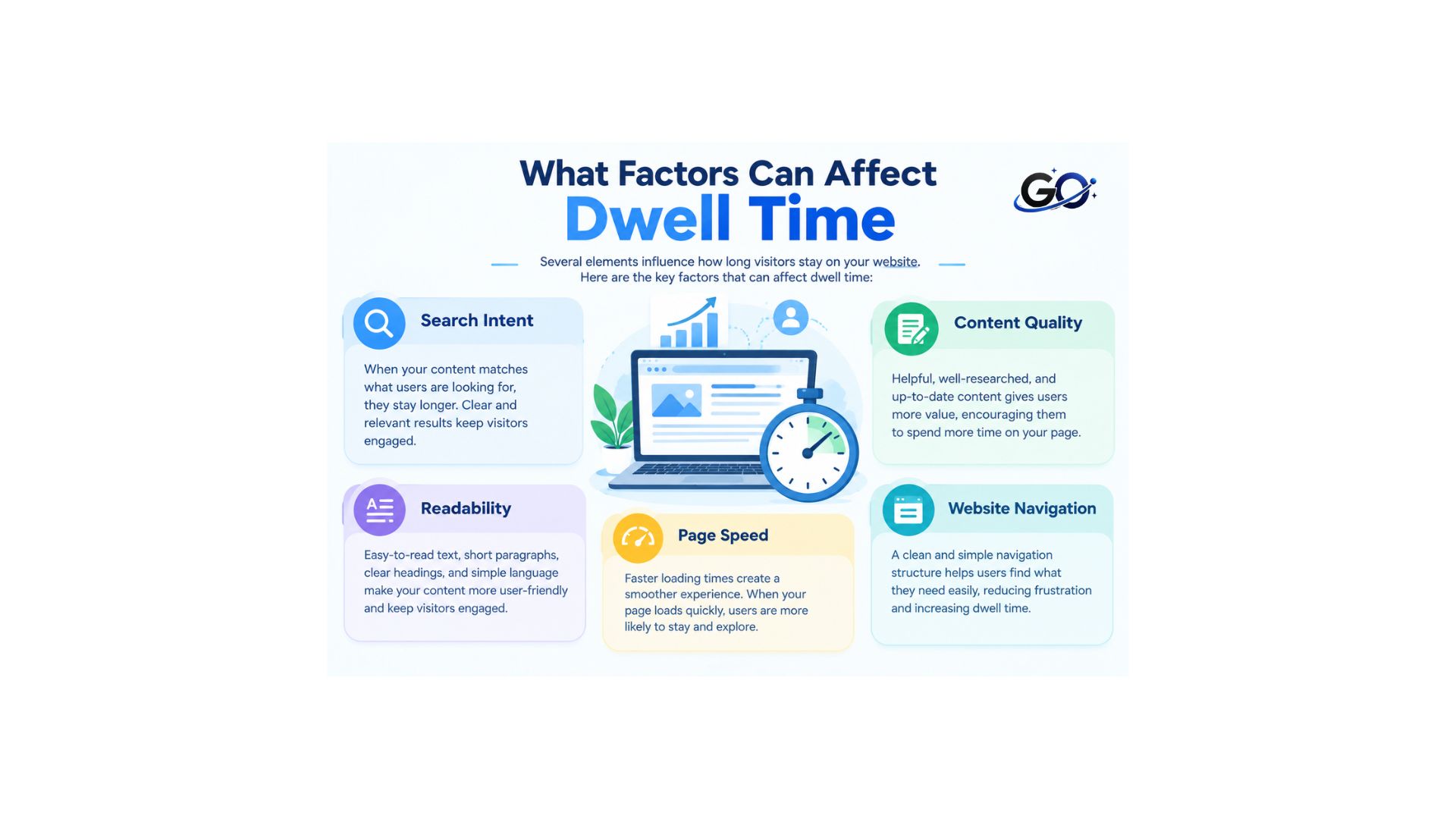
Numerous factors can affect how long visitors stay on a webpage.
Search Intent
The motivation behind a user’s search query is referred to as search intent. Comprehending search intent enables you to produce information that aligns with user preferences. You may enhance user experience and draw in more relevant traffic by focusing on the appropriate intent.
Content Quality
Make sure your material fulfils the user’s search intent and is of a high calibre. This could be giving thorough, thoroughly researched content for a blog post. Recommendations for content might potentially increase dwell time. You may entice users to stay on your website longer by making recommendations for relevant information.
Readability
Use headings and bullet points to divide your text into manageable chunks. Users will find it easier to read and comprehend your material as a result. For those who are reading your information on a phone, this is very important.
Page Speed
The speed at which a webpage loads and becomes functional for users is referred to as page speed. Both the user experience and SEO performance can be enhanced by a website that loads quickly. Pages can load more quickly by optimising code, graphics, and server response times.
Website Navigation
Visitors can quickly locate key pages and information on a website with the aid of website navigation. A well-defined navigation structure enhances user experience and facilitates search engine comprehension of your website. Overall usability can be enhanced by logical site organization, pertinent links, and straightforward menus.
How to Improve Dwell Time
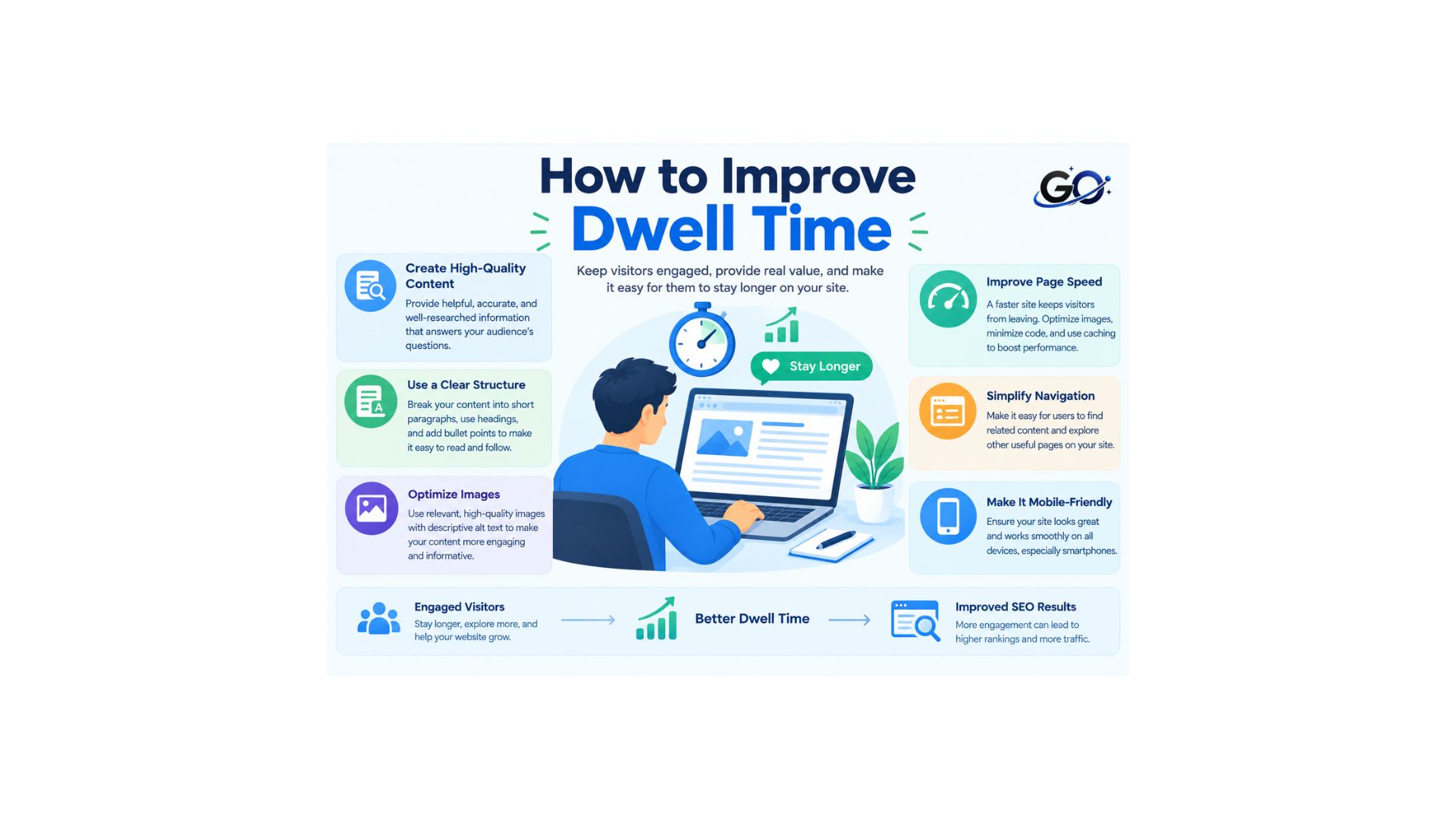
It is insufficient to simply put these suggestions into practice to increase dwell duration. You should monitor the dwell time of your webpages.
Additionally, you want to monitor how their search ranks evolve over time. This will assist you in determining whether SEO needs to be improved.
Unfortunately, since the Google Analytics interface does not display any such information, there is no direct way to track dwell time. However, dwell time can be computed indirectly.
You may monitor the average length of sessions and the quantity of pages viewed throughout each session with Google Analytics. You may examine what keeps users on your website longer and observe which page visits result in longer average session durations.
Is Dwell Time a Google Ranking Factor?
Let’s imagine you looked at the top-ranked article for this phrase in the search engine results, but you didn’t think it was useful.
You went back to the search results and clicked on the #2 result to see if it may provide a solution. This time, you spent five minutes reading the full post since the information was so outstanding.
This indicates to Google that people can get more value from the second-ranked website than from the first.
Do you believe Google will alter these two pages’ rankings?
Google has never officially acknowledged that dwell time is important for SEO. We are conscious of Google’s emphasis on user experience, though.
Common Dwell Time Mistakes
When attempting to increase visitor interaction, website owners may make a number of blunders.
Making content unnecessarily long: Longer content does not automatically provide more value.
Ignoring search intent: A page may attract clicks but fail to answer the user’s actual question.
Using clickbait titles: Misleading titles can create a poor experience when the content does not match the promise.
Adding unnecessary elements: Excessive pop-ups, videos, or advertisements can distract visitors.
Focusing on dwell time alone: Website performance depends on many factors, so one metric should not determine your entire SEO strategy.
Conclusion
Dwell time describes how long a visitor stays on a webpage after clicking a search result before returning to the search results.
Website owners can analyse visitor behaviour and find possibilities to improve their content by knowing how dwell time functions in SEO.
Concentrate on matching search intent, offering helpful responses, enhancing readability, and developing a quick and user-friendly website rather than attempting to control dwell time. These techniques can strengthen your overall SEO strategy and help visitors gain more value from your content.
FAQs About Dwell Time
1. How does dwell time affect SEO?
Increased page relevancy, average engagement duration, and reduced bounce rates all contribute to greater search rank, and longer dwell periods show that users are more pleased with the way web material is arranged and presented.
2. What is a good dwell time?
There are no trustworthy figures for ideal dwell time because dwell time is not an official Google metric. By looking at the average session duration metric, you can find some clues. A session should last between two and four minutes on average. A minute or less is not good.
3. How is dwell time calculated?
Although dwell time cannot be directly calculated, it can be estimated using techniques such as Google Analytics. Compare the analytics for time on page, bounce rate, and pages per session after creating a division solely for organic traffic.
4.What is the ideal dwell time for my content?
Different industries and types of content have different ideal dwell times. Generally speaking, give long-form content at least three to four minutes, and shorter bits one to two minutes. Meeting user intent is crucial, though; even shorter dwell durations can be useful if your content completely addresses the query.
5. What is dwell time and how does it differ from bounce rate?
While bounce rate encompasses all single-page sessions, regardless of length, dwell time explicitly evaluates the amount of time spent on a page before returning to SERPs. Even if a visitor stays on your website for a long period, they may still be considered a bouncer if they don’t go to other sites.