

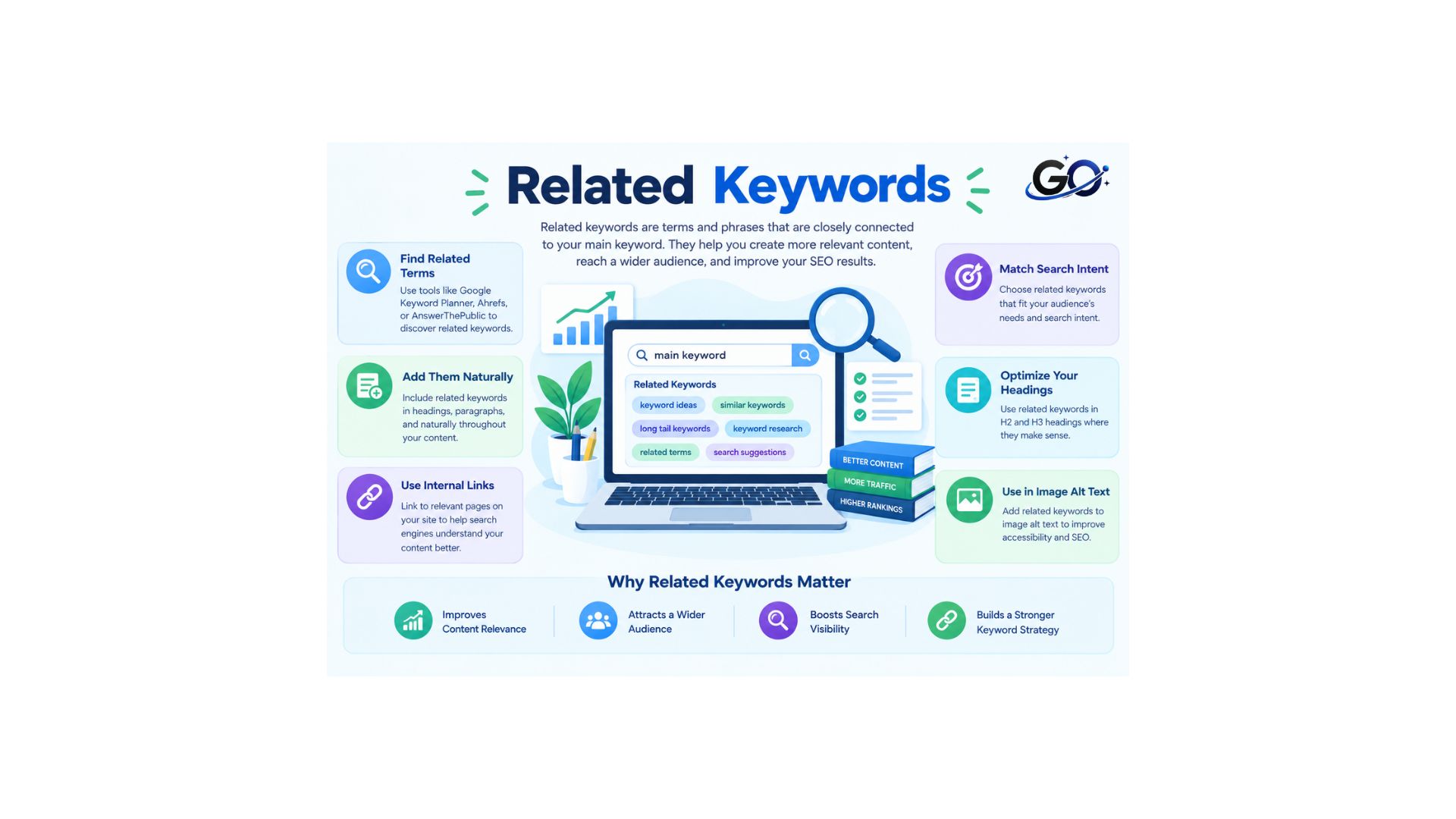
Related Keywords help search engines understand your topic, connect related concepts, and improve content relevance for search queries. They make it easier for search engines to understand the context of your content, increasing its relevance for a variety of searches. For example, if your primary keyword is “dog training,” related terms could include “puppy obedience tips” or “training a rescue dog.”
For example, if your main keyword is “SEO”, related keywords may include keyword research, backlinks, on-page SEO, technical SEO, search rankings, and organic traffic.
Why Are Related Keywords Important for SEO?
Related keywords are essential for SEO because they help you maximize a web page’s visibility in search results.
Instead of focusing on only one primary keyword, using related terms allows your content to rank for multiple search queries with a single piece of content.
Here are some additional benefits of SEO related keywords:
- Increased Organic Traffic: More visibility in search results means more visitors to your website.
- Enhanced User Experience: By addressing a broader range of related topics, you create a more satisfying user experience.
- Improved Keyword Rankings: When you make strategic yet varied keyword optimizations on a web page, you can rank for more keywords.
Related Keywords vs. Primary Keywords
The principal search phrase you want a webpage to target is called a prime keyword.
Supporting terms associated with the primary keyword help expand the topic and provide additional context.
For example:
Primary keyword: On-page SEO
Related keywords:
- Title tags
- Meta descriptions
- Header tags
- Internal links
- Image optimization
- Keyword placement
The primary keyword defines the main subject, while supporting terms help expand the topic and provide additional context.
Related Keywords vs. Synonyms
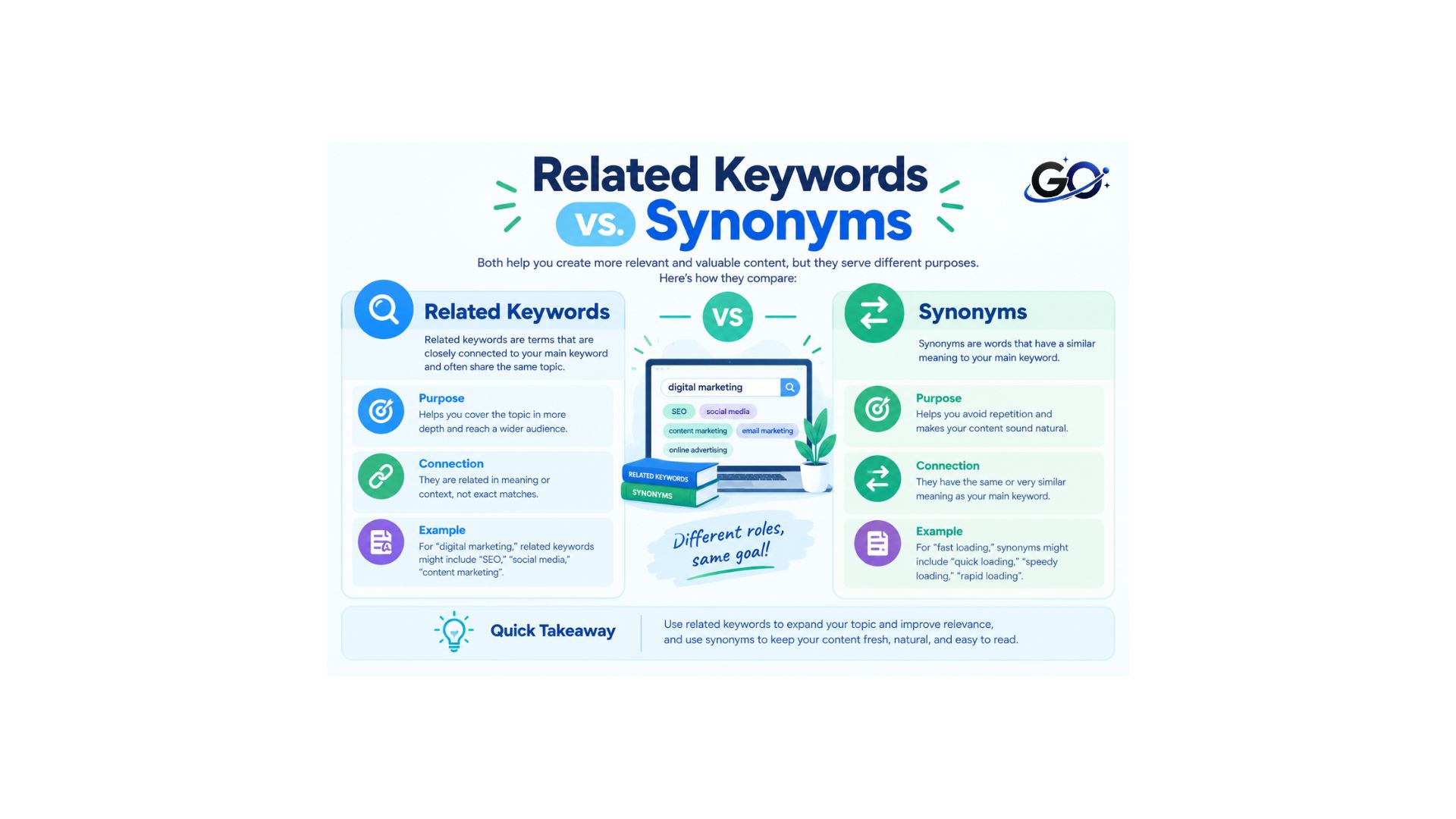
Related keywords and synonyms are connected, but they are not the same.
Synonyms have similar meanings.
For example:
Begin — Start
Related keywords are more closely associated with a subject.
For example, if the primary keyword is “SEO,” terms such as backlinks, technical SEO, keyword research, rankings, and organic traffic can support the topic.
As a result, supporting terms might include related concepts and subtopics, whereas synonyms primarily focus on similar meanings.
Examples of Related Keywords
Here are some examples from different SEO topics.
SEO
Main keyword: SEO
Related keywords:
- Search engine optimization
- Organic traffic
- Search rankings
- Keyword research
- Backlinks
- Technical SEO
Content Marketing
Main keyword: Content marketing
Related keywords:
- Blog content
- Content strategy
- Audience research
- Content creation
- Content promotion
- SEO content
Local SEO
Main keyword: Local SEO
Related keywords:
- Google Business Profile
- Local keywords
- Local citations
- Online reviews
- Local search
- Business directories
How to Find Related Keywords
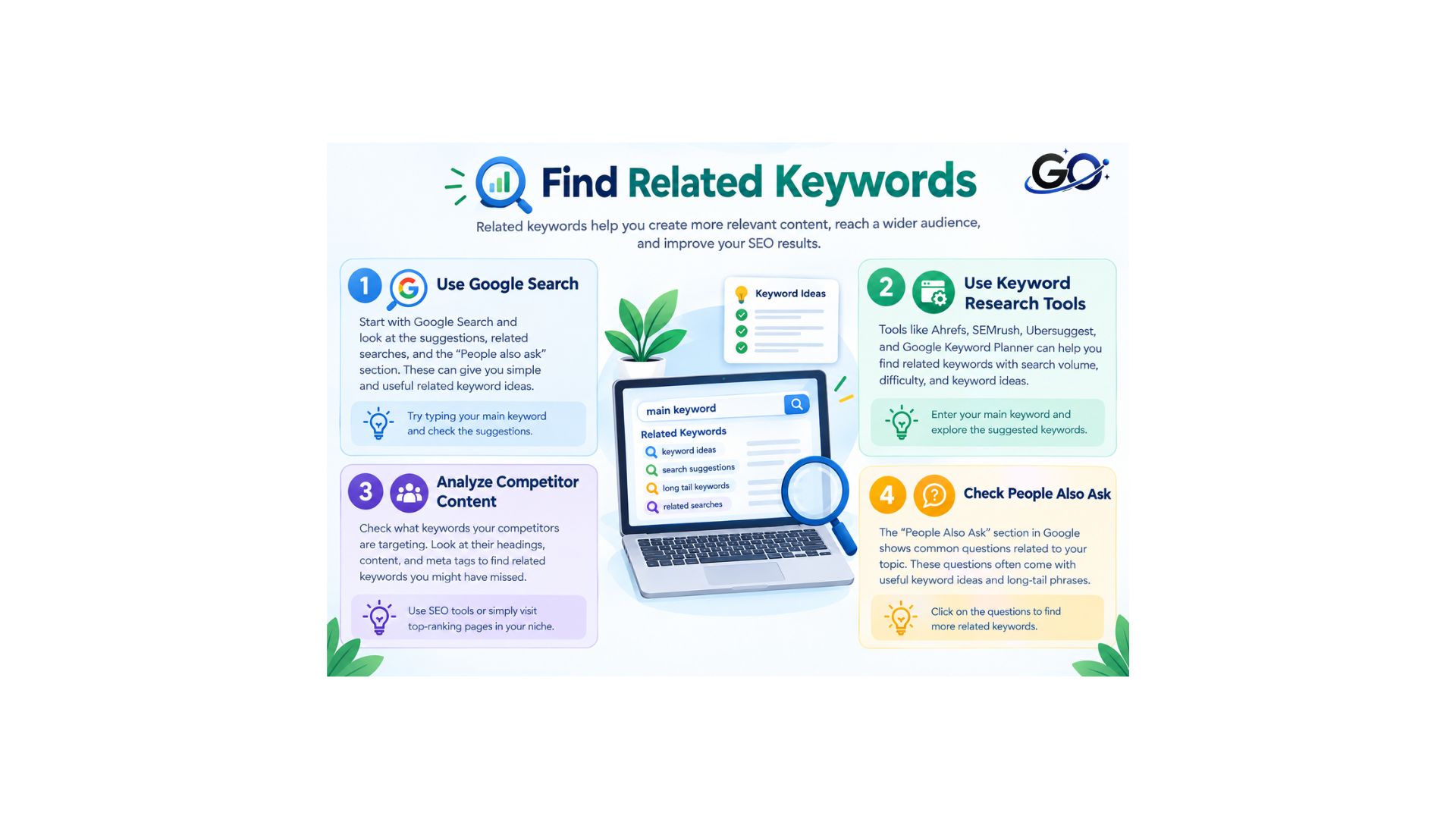
Finding relevant keywords does not have to be difficult. Several methods can help you discover useful terms.
Use Google Search
Don’t underestimate the power of Google search suggestions! When you start typing a query into Google, it automatically suggests related searches based on what others have looked for. This feature can be a goldmine for finding related keywords.
Use Keyword Research Tools
Keyword research tools can help you discover relevant search terms, questions, and variations. You can compare search volume, competition, and other metrics when selecting keywords for your content.
Analyze Competitor Content
Review high-quality pages that rank for your main keyword.Look at the topics, subheadings, questions, and related terms they cover. Use this research to identify useful topics that your own content should address.
Check People Also Ask
Additionally, explore the People Also Ask and People Also Search For sections or other SERP features. These sections provide insights into common questions and topics that users are interested in, alongside your primary keyword.
Aap is section ko thora more natural aur SEO-friendly bana sakte hain:
How to Use Related Keywords in Content
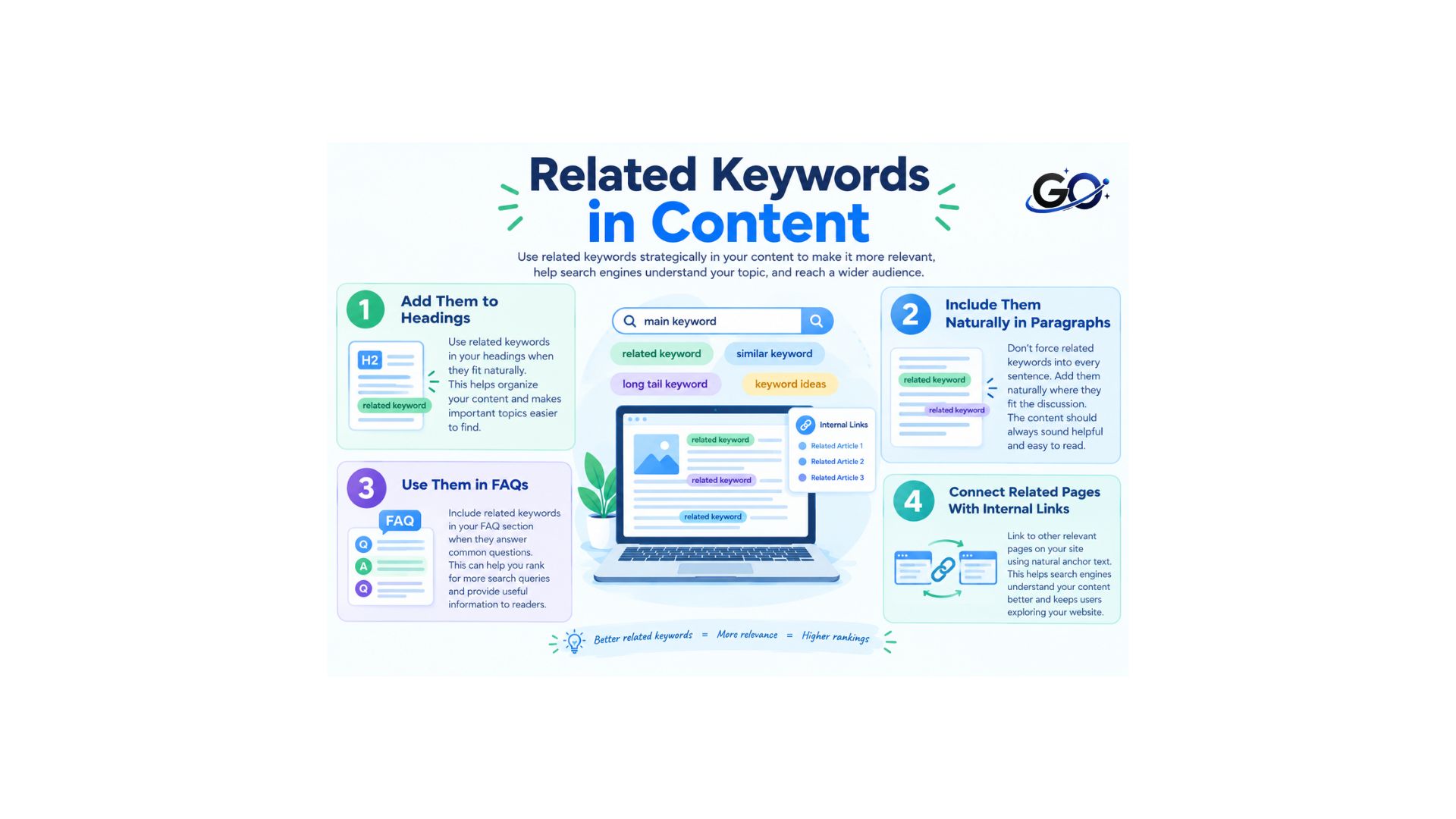
After finding relevant search terms, use them naturally throughout your content. Place them where they add context and help readers understand the topic. Avoid keyword stuffing and focus on creating clear, useful, and easy-to-read content.
Add Them to Headings
When the headlines accurately explain the segment, use pertinent related keywords. This aids in content organization and facilitates readers’ access to key subjects. Additionally, it provides search engines with additional context regarding the topics you cover on your page.
Include Them Naturally in Paragraphs
Don’t stuff every paragraph with relevant keywords. Only include them when they make sense for the conversation and offer helpful background. This helps search engines comprehend the main topic and related elements while maintaining the readability of your text.
Use Them in FAQs
You can write helpful FAQ sections that answer frequently asked questions by using related questions. Questions about keyword difficulty, search volume, long-tail keywords, and keyword research tools, for instance, could be addressed in an article about keyword research.
Connect Related Pages With Internal Links
Use internal links to link relevant sites so that visitors can find more helpful content on your website. Use natural anchor language to link to pertinent articles, manuals, or service pages. This enhances website navigation and aids search engines in comprehending the connections between various pages.
Common Mistakes With Related Keywords
Marketers should avoid several common mistakes when using supporting terms.
Keyword stuffing: Adding too many keywords can make content unnatural and difficult to read.
Using irrelevant terms: A keyword should have a genuine connection to the topic.
Ignoring search intent:Supporting terms should match what users want to find..
Focusing only on keywords: Content quality and usefulness should remain the priority.
Using keywords without context: A supporting term should fit naturally within the sentence and section.
Conclusion
Related keywords are an important part of modern SEO content. They help expand a topic, provide additional context, and allow writers to create more natural and comprehensive articles.By researching relevant terms and using them naturally in headings, paragraphs, FAQs, and internal links, you can create content that better addresses user needs.
The key is to focus on relevance and usefulness rather than adding keywords simply for SEO. High-quality content should always provide clear answers and a valuable experience for readers.
FAQs About Related Keywords
1. What are related keywords?
Related keywords are search terms closely connected to your main keyword and show different ways people search for the same topic. These terms are often less obvious than your seed keyword, so competitors may overlook them, making them easier to rank for. Keywords Everywhere can help you find these search terms along with their Google search volume.
2.What are related keywords good for in SEO?
They expand a single page or campaign into the full set of terms your audience uses, so you can cover a topic properly and pick up searches your competitors miss. Because they come directly from Google and Bing, they are real demand rather than a guess, and the search volume next to each one tells you which are worth targeting first.
3. How do I find related keywords?
Install the Keywords Everywhere extension, then search on Google or Bing as usual. A “Related Keywords” widget appears on the right of the results with the terms closely tied to your query, and a “People Also Search For” widget sits below it. The keywords come straight from the search engine, so they reflect what people actually search.
4.Where do the related keywords come from?
They come directly from Google and Bing, using the same search suggestions that the engines display for a query. Keywords Everywhere collects these terms from the results page and adds useful metrics. Since the engines control which suggestions appear, some searches may show many terms while others may show none.
5. Can I see the search volume for related keywords?
Yes. For each related search term and People Also Search For keyword, Everywhere can display the monthly Google search volume, CPC, and competition. Each keyword uses one credit, but you can keep these metrics turned off by default and load them only when needed using the “Load Metrics” button to conserve credits.