
Learn what on-page SEO is in digital marketing and discover the best techniques to optimize your website for higher rankings and traffic.A collection of digital marketing strategies known as “on-page search engine optimisation” (SEO) can help your website rank better on search engine results pages (SERPs). It entails making your webpages more visible in search results by optimising their content. Adding keywords and phrases that your target audience is looking for to particular sections of your website is one of the essential strategies.
On-Page SEO, Off-Page SEO, and Technical SEO are the three primary subcategories of SEO. Among these, On-Page SEO is the foundation of every successful SEO strategy because it focuses on optimizing the elements you can control directly on your website. From writing high-quality content to improving page speed and optimizing images, every detail contributes to better search engine rankings and a better user experience.
What Is On-Page SEO?
The process of improving individual web pages to rank higher in search engine results and give users a better experience is known as “on-page SEO.” Enhancing the text, headings, title tags, meta descriptions, graphics, URLs, intSubmit Your Sitemap to Google Search Consoleernal links, and other on-page components are all part of it.
The goal of On-Page SEO is to help search engines understand the purpose of your page while ensuring users can easily find the information they need.
Unlike Off-Page SEO, which focuses on backlinks and external signals, On-Page SEO involves making improvements directly on your website.
For example, if you publish an article about digital marketing, On-Page SEO ensures that the page contains relevant keywords, descriptive headings, optimized images, internal links, and a clear page structure that both users and search engines can understand.
Why Is On-Page SEO Important?
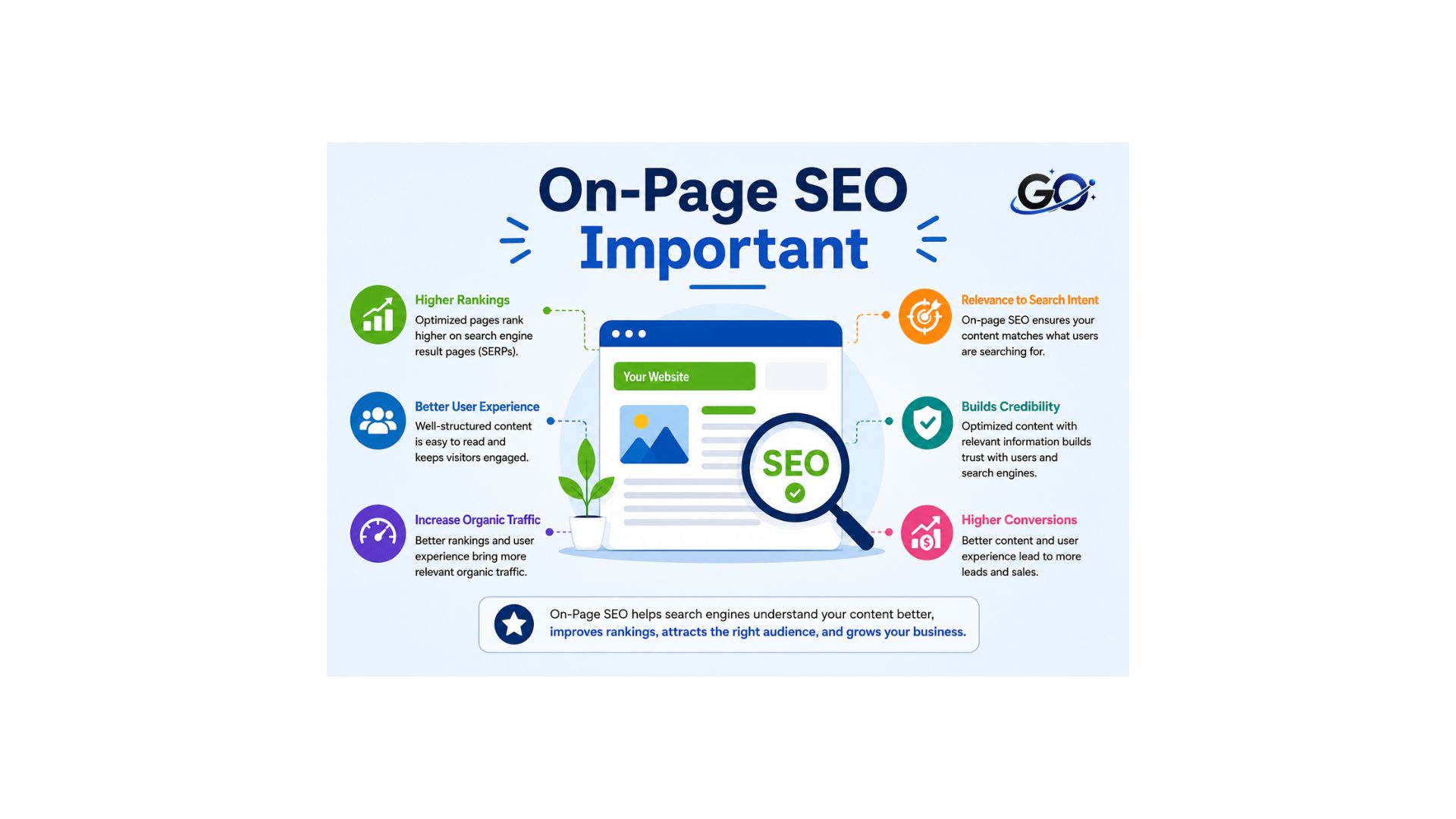
The goal of search engines is to deliver the most pertinent and helpful results to users. Search engines can better comprehend your content and assess if it aligns with the user’s search intent thanks to on-page SEO.
Here are some of the biggest benefits of On-Page SEO:
Improves Search Rankings
Proper optimization helps search engines crawl and index your pages more efficiently, increasing your chances of ranking higher.
Increases Organic Traffic
Higher rankings usually lead to more clicks from users searching for related topics.
Enhances User Experience
Well-organized content, faster loading speeds, and mobile-friendly pages create a better browsing experience.
Builds Website Authority
High-quality content and proper optimization increase trust among both users and search engines.
Boosts Conversion Rates
Visitors are more likely to subscribe, contact you, or purchase your products when your website is easy to use and informative.
Key Elements of On-Page SEO
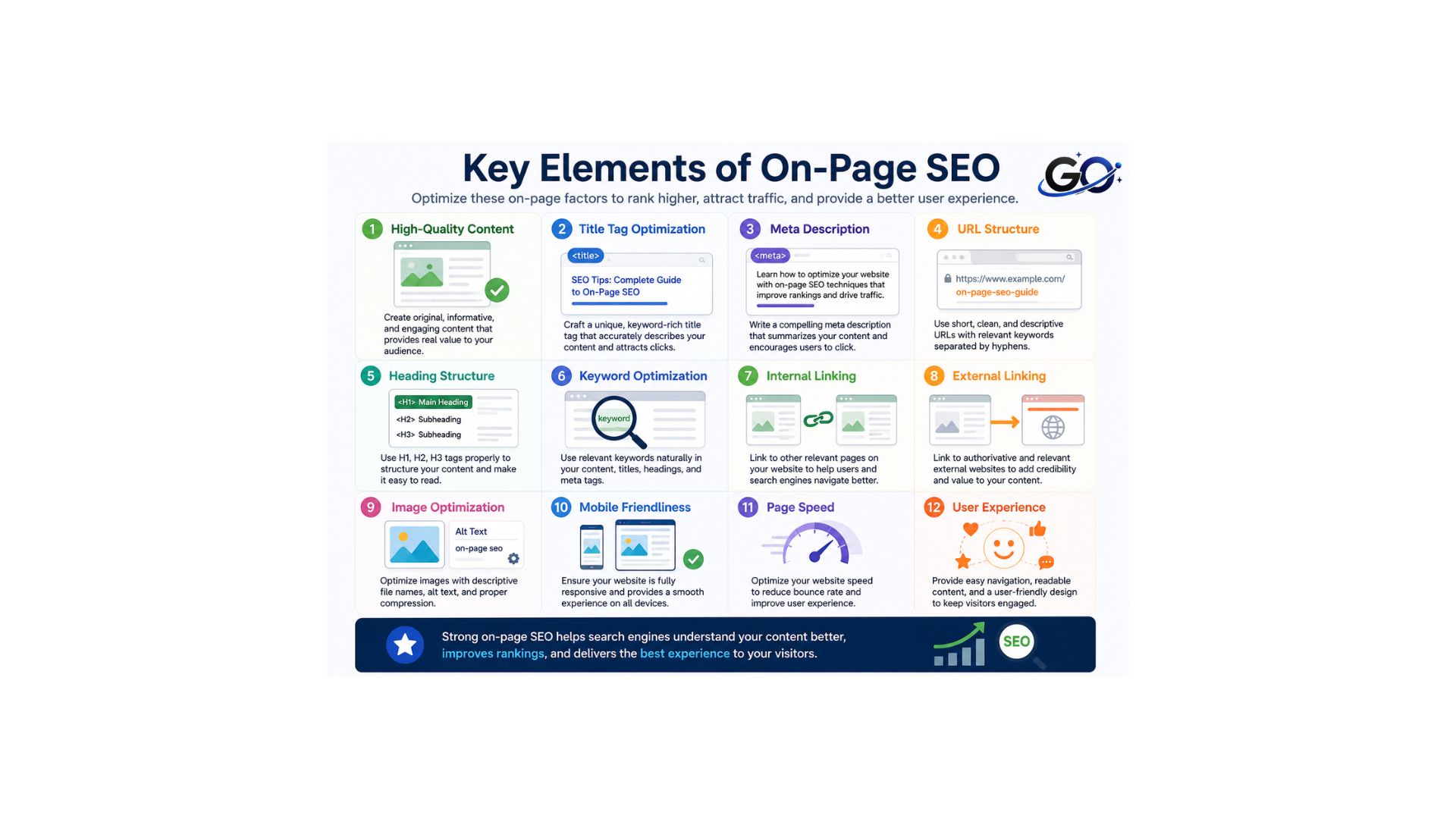
1. High-Quality Content
High-quality content is a key part of On-Page SEO in Digital Marketing. It is essential to create content that appeals to your target audience, matches their search intent, is grammatically correct, informative, and well-structured. Visitors who find valuable and relevant information are more likely to spend more time on your page and return in the future, which helps improve your website’s SEO performance.
Visitors will benefit from this since it guarantees that they will discover interesting content that relates to their demands or interests. This will help increase dwell time—the amount of time a user spends looking at a page. Visitors will be encouraged to return if they find the content on your website beneficial. Increased page traffic is beneficial to SEO since it tells search engines that your website is an authority on the subject you have selected.
2. Title Tag Optimization
This is the headline of a page that shows up on search engine results pages (SERPs) and is one of the primary things that viewers will notice as they browse. It is also referred to as a meta title. Title tags are a wonderful way to draw in audiences and encourage them to click on your website by providing a brief overview of a page’s content to both users and search engines before they visit. If it makes sense, it’s a good idea to insert a pertinent keyword here.
3. Meta Description
This page summary elaborates on the content of your page and is displayed beneath the title tag in search engine results pages. In order to fit within the search engine preview, it is usually restricted to 160 characters; nevertheless, depending on your preferred search engine, it may occasionally be computed in megapixels. Make use of this area to draw attention to the main features of your website and entice searchers to visit it.
4. URL structure
Your webpage’s address is its URL, which stands for Uniform Resource Locator. Through a search engine, an internal link, a backlink, or just entering the URL into a browser, visitors can access your website.
Including keywords in your URL helps users and search engines understand the content of your page and indicates where it is located on your website. For instance, squarespace.com/price makes the content of the page obvious to browsers before they even click through and aids search engines in classifying the page as a plan pricing page.
5. Heading Structure
A well-organized heading structure improves both user experience and on-page SEO. Use one H1 heading for the main topic, followed by H2 and H3 headings to divide your content into clear sections and subtopics. This helps search engines understand your page hierarchy while making the content easier for readers to scan. A logical heading structure also increases readability and supports better SEO performance.
6. Keyword Optimization
Keywords help search engines understand your content and match it with relevant user searches. To optimize your page effectively, place your primary keyword naturally in important locations, including the title tag, URL, meta description, introduction, headings, conclusion, and image alt text.
Instead of repeating the same keyword multiple times, use related terms, synonyms, and natural keyword variations. This approach improves readability, enhances topical relevance, and supports better on-page SEO performance.
7. Internal Linking
Adding links to move between pages on your website is known as internal linking. From a user experience standpoint, this is beneficial since it makes it easier for users to navigate between pertinent pages and prolongs their time on your website. It displays relevant pages to search engines for SEO purposes.
8. External Linking
External links help readers find useful information beyond your website. When you link to trusted and relevant sources, your content becomes more reliable and informative. These links support your points with credible references and give users a better learning experience. Search engines also consider quality external links a positive signal of trust. Always choose authoritative websites that are closely related to your topic instead of linking to random or low-quality pages.
9. Image Optimization
This is about ensuring the images on your webpage can be understood when someone can’t view an image and by search engines.Search engines rely on alt text descriptions on your webpage to classify photos because they are unable to view the images on your pages as your users normally would.
It’s important to make your alt text as descriptive as you can without becoming too lengthy. Whilst it will not be visually present on your webpage, audiences will be able to read this via screen readers.
Also consider image size and type. An image file that is too large could cause your website to load more slowly. rge image files where possible to aid load speed without losing out on quality and limiting large animated images. If you have the means to produce original imagery rather than stock photos, it’s worth exploring, as this can aid ranking in image searches.
10. Mobile Friendliness
This is how well your site functions when visited on a mobile device. If you are building your web page in desktop format only, page elements may appear in the wrong dimensions when visited on a phone or alternative format. This could make text unclear or links inaccessible if only optimized for computer or tablet viewing.
11. Page Speed
This measures how quickly a page and its respective elements load on all devices, the primary being mobile and web. If load speed is too slow, users may be more likely to exit your site and find it difficult to use. This affects dwell time, which can negatively impact your site’s ranking.
12. User experience
User experience considers the ease, smoothness, and accessibility of use for visitors to your site. Although there are numerous contributing factors, some of the most significant ones are listed here.
- Navigation: Navigation covers your visitors’ ability to move from one part of your website to another. The principal site navigation bar and internal links to other pages on your website make up the internal navigation of your website. If your page navigation is unclear or pages are incorrectly linked, it can cause user churn and negatively affect your rankings.
Best Practices for On-Page SEO
Following proven best practices can improve your website’s performance over time.
- Write original and valuable content.
- Focus on user search intent.
- Include keywords naturally.
- Optimize title tags and meta descriptions.
- Use descriptive headings.
- Create SEO-friendly URLs.
- Add internal links to related pages.
- Link to reliable external sources.
- Optimize all images.
- Improve page loading speed.
- Make every page mobile-friendly.
- Update old content regularly.
Consistency is more important than making one-time changes.
Common On-Page SEO Mistakes
Even experienced website owners sometimes make optimization mistakes.
Avoid these common issues:
- Keyword stuffing
- Duplicate content
- Missing title tags
- Poor meta descriptions
- Weak headings
- Broken internal links
- Large image files
- Slow loading pages
- Ignoring mobile users
- Publishing thin content
Frequent SEO audits assist in locating and resolving these issues.
On-Page SEO vs Off-Page SEO
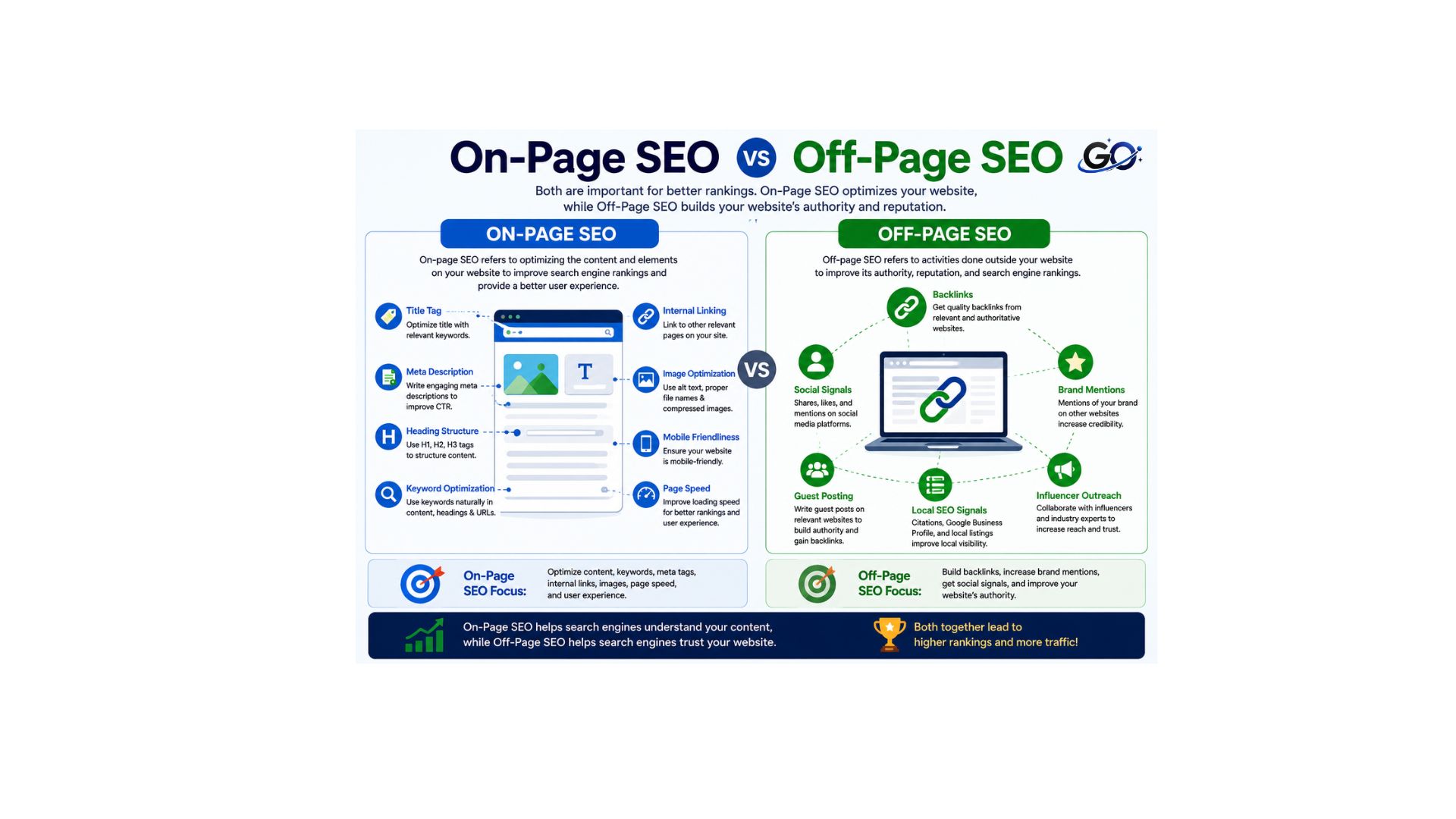
On-page SEO involves performing tasks on webpages (i.e., internally) to improve a site’s search visibility, while off-page SEO involves performing tasks outside of a site (i.e., externally) to achieve the same objective.
For example, writing unique, helpful content is an on-page SEO techniqueObtaining backlinks to the material is an off-page SEO strategy.
| On-Page SEO | Off-Page SEO |
| Content optimization | Backlink building |
| Title tags | Brand mentions |
| Meta descriptions | Social signals |
| Internal linking | Guest posting |
| Image optimization | Online reputation |
| URL structure | Referral traffic |
| Page speed | External authority |
Successful SEO campaigns combine both strategies.
On-Page SEO Checklist
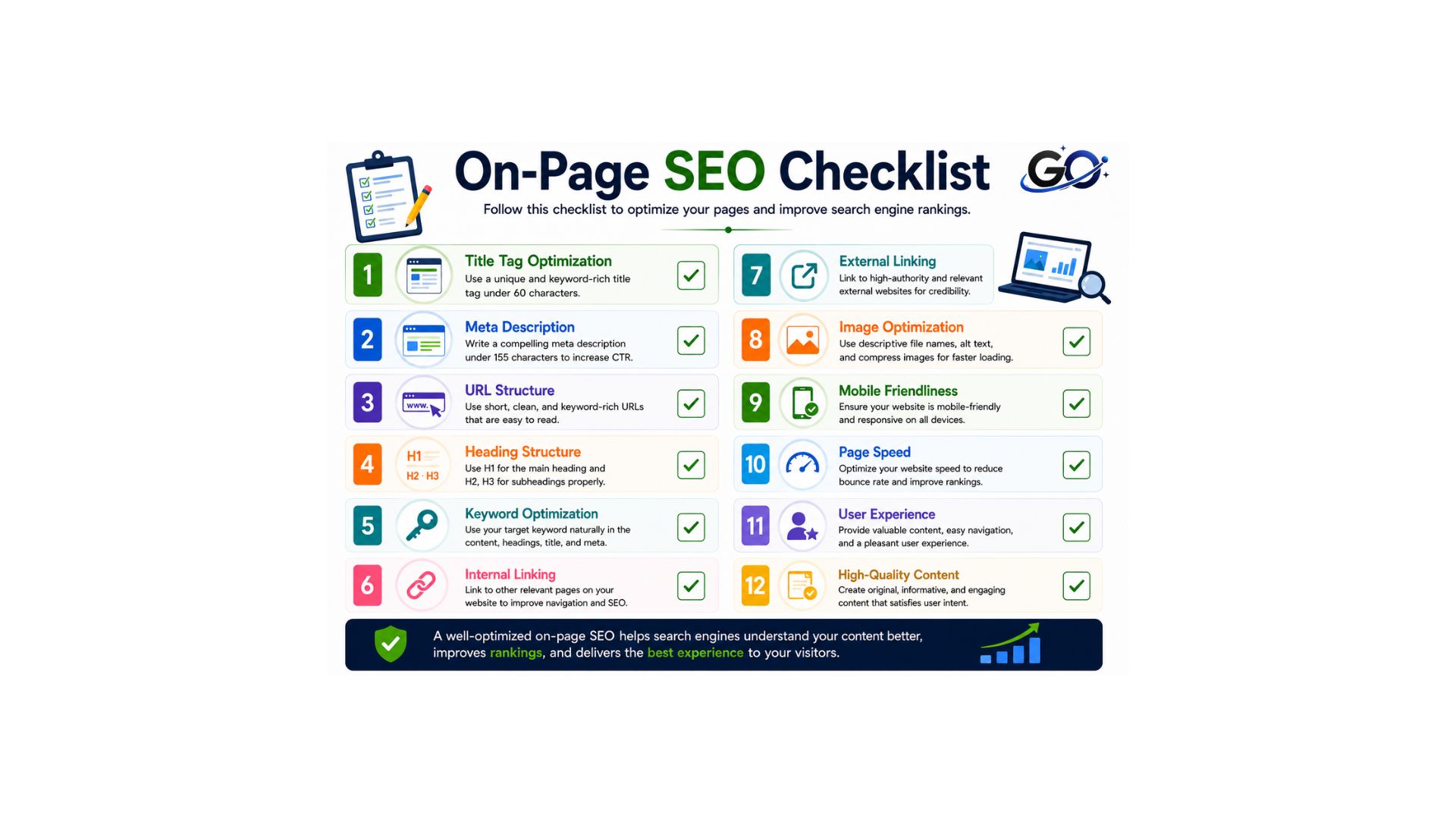
Before publishing any webpage, check the following:
- Primary keyword included in the title
- Optimized meta description
- SEO-friendly URL
- One H1 heading
- Clear H2 and H3 headings
- Original and helpful content
- Internal links added
- External links to trusted sources
- Images compressed
- Alt text added to images
- Mobile-friendly layout
- Fast loading speed
- Easy-to-read formatting
This checklist helps ensure every page is fully optimized.
Conclusion
On-Page SEO in digital marketing is the practice of optimizing the content and structure of individual web pages to improve search engine rankings and provide a better user experience. It includes optimizing titles, meta descriptions, URLs, headings, keywords, images, internal links, page speed, and mobile responsiveness.
A well-optimized page makes it easier for search engines to understand your content while helping visitors find accurate and valuable information. By consistently applying On-Page SEO best practices, businesses can increase organic traffic, improve online visibility, strengthen website authority, and generate more leads over time.