

Synonyms help improve writing by reducing repetition, making content more engaging, and expressing ideas clearly. They help writers and speakers express ideas in different ways without changing the main meaning.
For example, “happy” and “joyful” have similar meanings. Likewise, “begin” and “start” can often be used in the same context.
Reading comprehension, writing quality, vocabulary, and communication can all be enhanced by knowing alternative words.
What Are Synonyms?
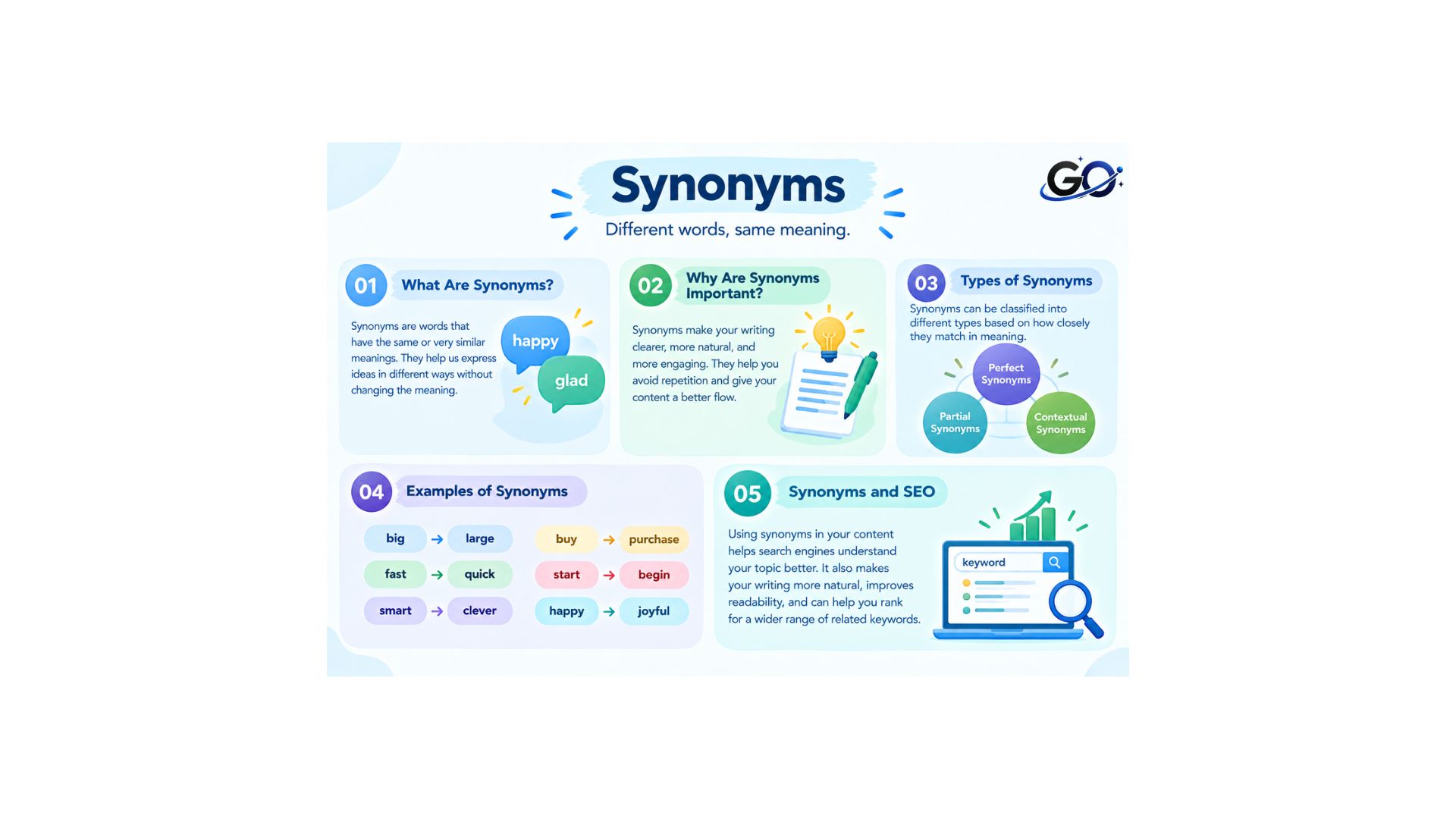
Synonyms are different words that have the same or similar meanings. Every word class and part of speech, including nouns, verbs, adjectives, adverbs, and prepositions, contains them.
Let’s take a closer look at similar words as an example. Good is one of the most widely used terms, and it has several alternatives with similar or nearly the same meanings, such as fine, excellent, satisfactory, outstanding, and superb.
However, these words do not always have exactly the same meaning. For example, excellent describes a very high level of quality, while satisfactory suggests that something meets an acceptable standard. Even so, the main principle remains the same: each alternative expresses the general idea of something being good, although the level or context may differ.constructive.
Why Are Synonyms Important?
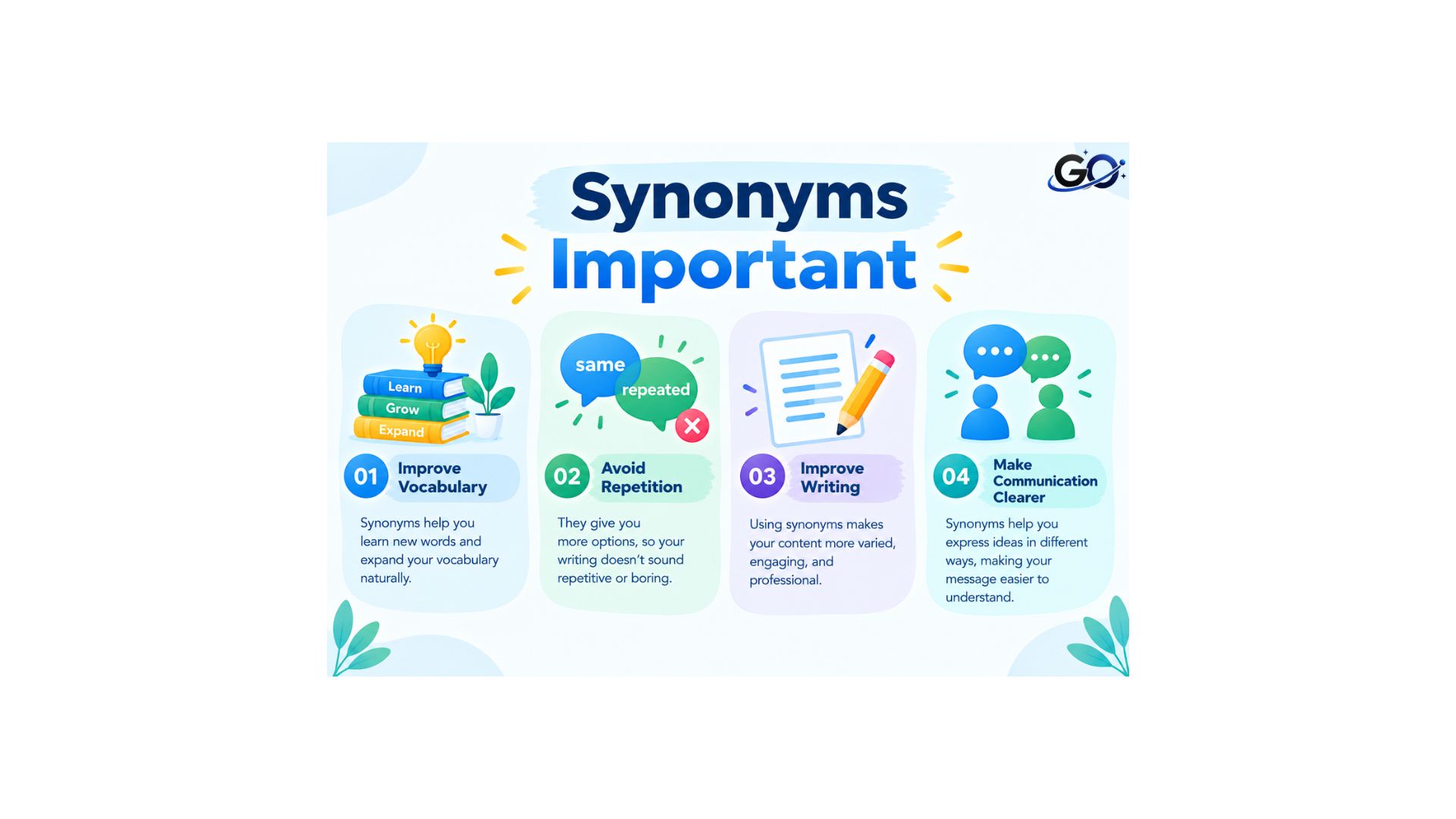
Both written and oral communication can benefit from the usage of synonyms. When conveying an idea, they offer more options.
Improve Vocabulary
Acquiring synonyms aids in vocabulary growth. You have a number of options rather than depending just on the same popular phrase.
This can make communication more flexible and effective.
Avoid Repetition
Writing might become less interesting if a word is used repeatedly. You can use synonyms to convey comparable ideas with different terms.
For example, instead of repeatedly using “important,” you can sometimes use words such as “significant,” “essential,” or “valuable.”
Improve Writing
Articles, essays, emails, and other types of writing can be made more diversified by using appropriate synonyms.
Nonetheless, you should always use a synonym that complements the sentence’s meaning and context.
Make Communication Clearer
A notion can be more precisely explained with the use of the appropriate synonym. Words can convey somewhat varying stress levels, tones, or meanings.
Types of Synonyms
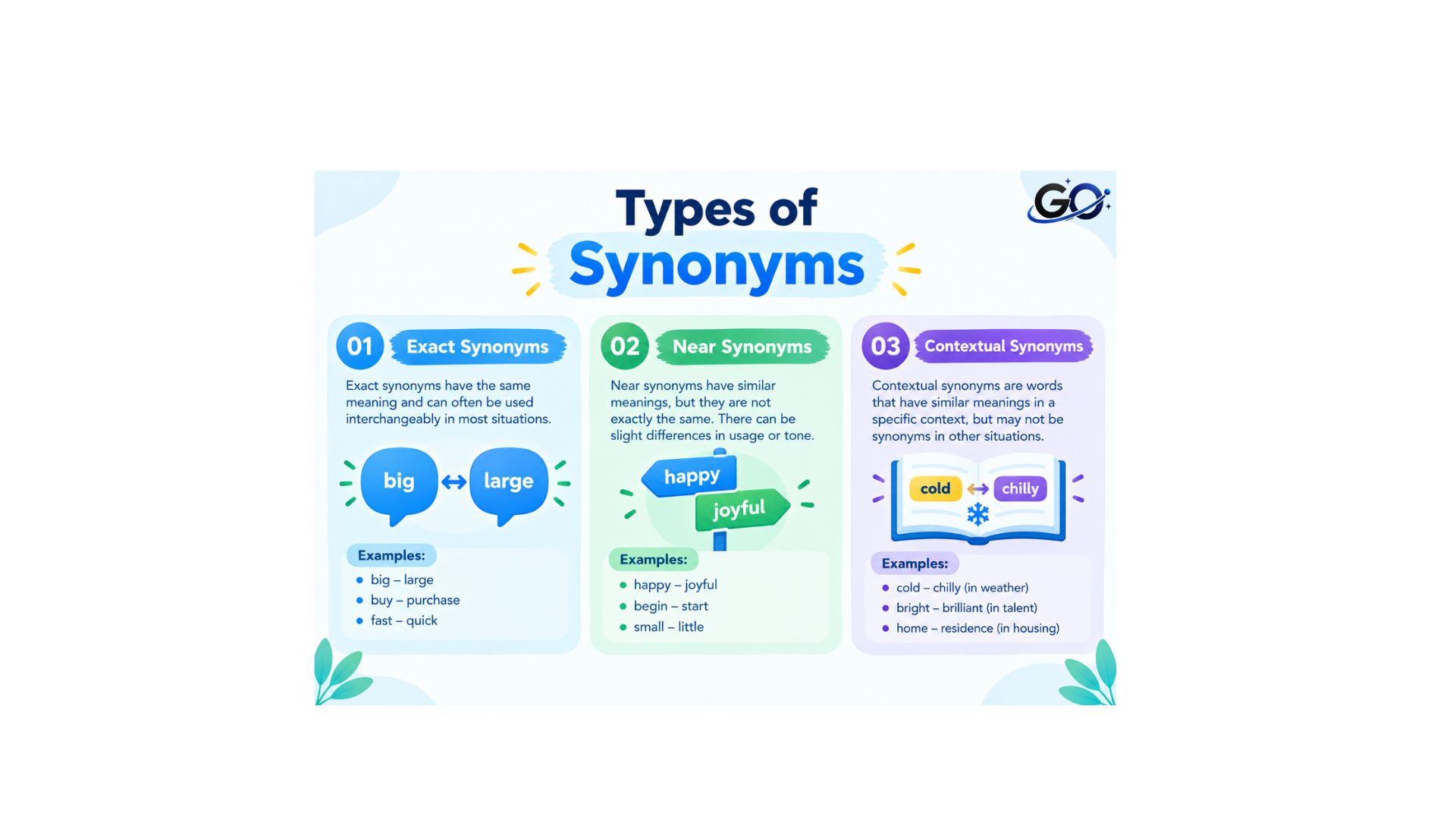
Synonyms can have different relationships depending on their meanings and usage.
Exact Synonyms
Exact matches are words that have the same or nearly the same meaning. They can frequently be used interchangeably without altering a sentence’s basic premise. However, completely precise matches are rare because words can differ in usage or tone. Understanding these distinctions helps you select the appropriate word for your subject.
For example: Big and large have nearly the same meaning in many sentences.
Near Synonyms
Near-synonyms are words that have different meanings, but their meanings are still related. These terms cannot be used interchangeably; substituting a near-synonym for a word conveys a different meaning. A near-synonym, however, might be a better and more appropriate word choice than the original because of their relationship.
For example: “big” and “huge” both describe size, but “huge” usually suggests something larger.
Contextual Synonyms
Contextual synonyms are words with similar meanings that fit a specific situation or sentence. In some situations, they might not be perfect substitutes. Your writing becomes clearer and more organic when you use the appropriate contextual synonym.
For example: “bright” can mean intelligent when describing a person, but it can also describe something that produces a lot of light.
Examples of Synonyms
| Word | Synonym |
| Word | Synonyms |
| Happy | Cheerful, joyful, content, pleased |
| Sad | Miserable, unhappy, sorrowful, downcast |
| Slow | Sluggish, leisurely, unhurried, delayed |
| Fast | Quick, speedy, rapid, swift |
| Small | Petite, tiny, little, miniature |
| Big | Huge, large, massive, immense |
| Begin | Commence, start, launch, initiate |
| End | Conclude, finish, cease, terminate |
| Strong | Powerful, robust, sturdy, resilient |
Synonyms and SEO
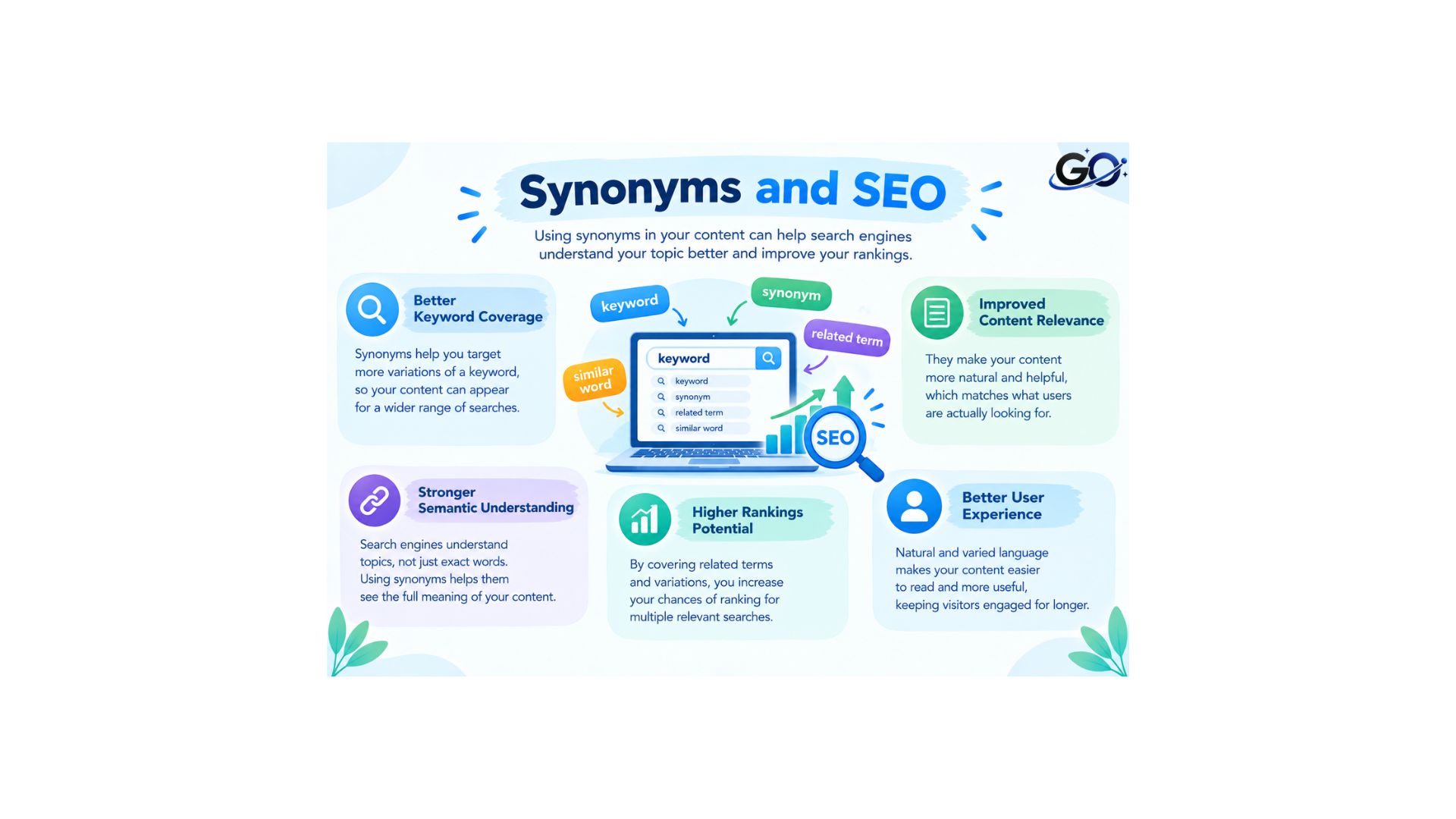
Synonyms can also support SEO content when writers use them naturally.Search engines are able to comprehend linked terms and ideas. As a result, content does not always have to use the same keyword repeatedly.
For example, where they appropriately relate to the subject, related terms like site optimisation, web optimisation, and website performance can be used on a page discussing website optimisation.
Content can become more organic and helpful for viewers by using related terms. However, keyword stuffing should not be justified by using alternative words. The primary objective should always be to create readable and useful material.
Synonyms vs. Antonyms
The word “synonym” is frequently used when discussing words with similar meanings. Words with opposite meanings are called antonyms, while this term refers to words that have the same or similar meanings. For example:
- Antonym of happy: sad
- Synonym of happy: joyful
You can learn synonyms and antonyms by using a dictionary or thesaurus. Additionally, Grammarly has a useful feature that allows you to double-click a word to view commonly used alternatives. This makes word selection easier and helps you create clearer and more engaging content.
How to Find Synonyms
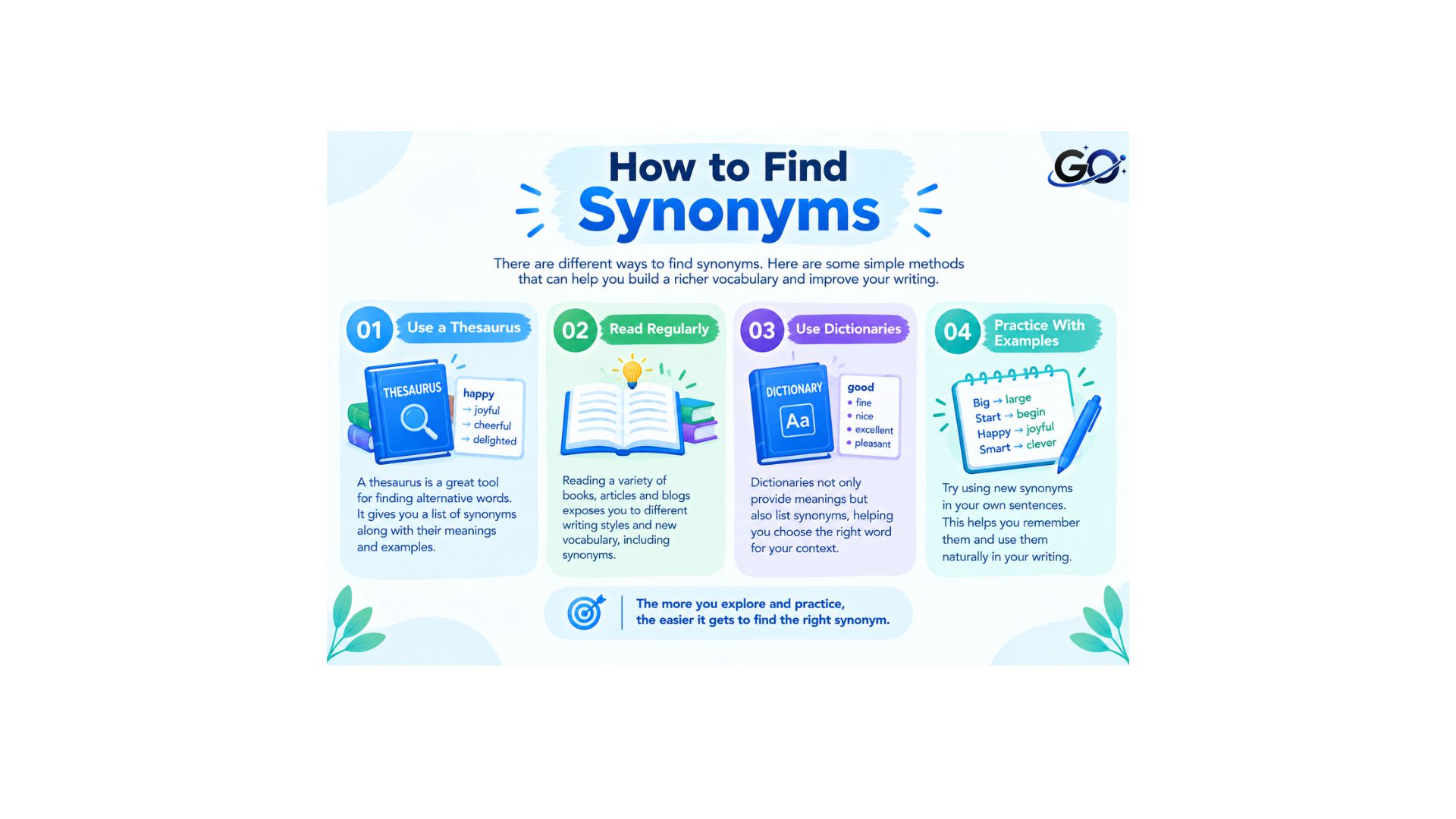
You can find synonyms using several resources and methods.
Use a Thesaurus
A thesaurus helps you find different words with similar meanings. It improves your vocabulary and makes your writing more varied. You can use it to avoid repeating the same words too often. Always choose a synonym that fits the context.
Read Regularly
Reading regularly helps you learn new words and their meanings. Books, articles, and blogs show how different words are used in context. This can help you understand synonyms more naturally. Regular reading also improves your overall writing skills.
Use Dictionaries
Dictionaries help you understand the exact meaning of words. They can also provide synonyms, examples, and information about word usage. Checking a dictionary helps you choose the right alternative. This makes your writing clearer and more accurate.
Practice With Examples
Practicing synonyms in different sentences helps you understand their proper use. Try replacing common words with suitable alternatives while keeping the original meaning. This practice improves your vocabulary and writing style. Over time, choosing the right words becomes easier.
Common Mistakes When Using Synonyms
Synonyms are helpful, but utilising them improperly might lead to issues.
Ignoring context: A similar word may not have exactly the same meaning in every situation.
Using overly complex words: Difficult vocabulary does not always improve writing.
Changing the meaning: Some alternative words have slightly different meanings or levels of intensity.
Overusing synonyms: Constantly replacing words can make writing sound unnatural.
Ignoring tone: A formal synonym may not suit casual communication.
Conclusion
Synonyms are an important part of effective communication. They allow writers and speakers to express similar ideas using different words.They can increase vocabulary, cut down on repetition, and create more interesting content.
Always keep context, meaning, tone, and readability in mind when choosing alternative words. The most difficult word is not always the best choice. Select a term that naturally and clearly expresses your thoughts while keeping the content easy to understand.
FAQs About Synonyms
1. How can I find synonyms for a word?
A dictionary, thesaurus, or online synonym tools can be used to find synonyms. These resources offer a variety of terms with comparable definitions. Prior to selecting a synonym, always consider the context and meaning. This enables you to write with the best word possible.
2. Why are synonyms important in writing?
Because they make your writing more engaging and readable, synonyms are useful for avoiding repeated words. They help you express ideas in different ways without changing the main meaning. Using suitable alternatives can also improve the clarity and natural flow of your writing.
3. What are synonyms and antonyms?
English language arts includes both synonyms and antonyms, which have different relationships in meaning. Words with the same or similar meanings belong to the first group, while words with opposite meanings are called antonyms. Both can add variety to writing, improve word choice, and make content more engaging for readers.
4. How can I remember synonyms effectively?
Repetition and connections help memory function well. Instead of memorizing isolated lists, practice new words in sentences right away, group similar words according to themes, and create visual word maps. Using spaced repetition with flashcards after one day, three days, and one week can help move these words into long-term memory.
5. How do synonyms help with SEO?
By adding variety and naturalness to content, synonyms can support SEO. They help search engines understand related terms and identify the main topic of a page. Additionally, using relevant alternatives can help content match different search queries while improving readability.