

Transition words are an important part of clear and well-structured SEO content. They connect sentences, paragraphs, and ideas so readers can easily understand how different points relate to each other. Words such as however, therefore, additionally, for example, similarly, and finally can guide readers through an article and create a smoother reading experience.
In SEO content, using transition words naturally can improve readability and make information easier to follow. This is especially important for long-form articles, guides, tutorials, and informational pages where several ideas need to be connected. However, transition words should not be added simply to increase a readability score. They should support the meaning of the content and make the writing feel natural.
What Are Transition Words
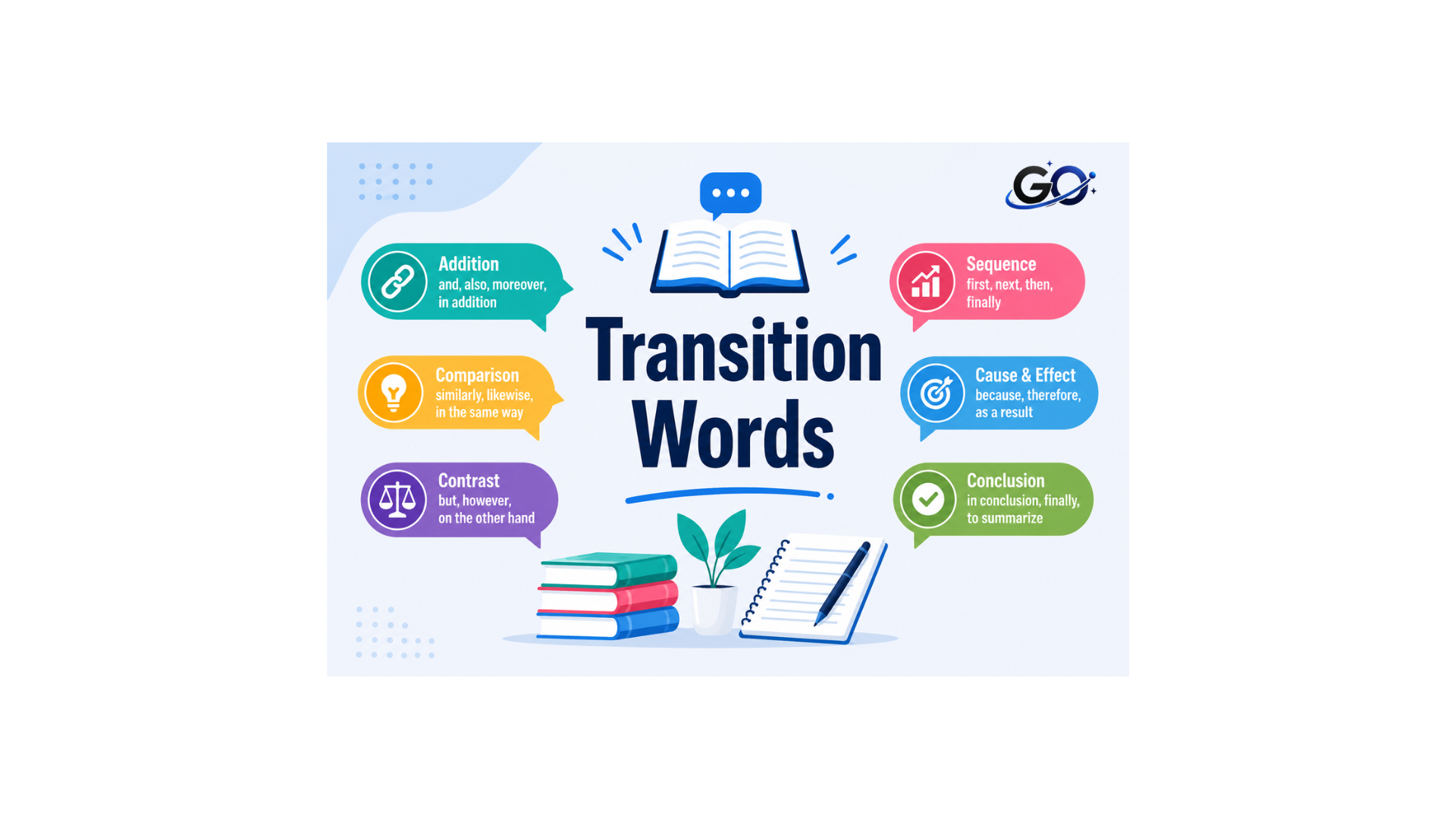
Transitional words establish connections between words, phrases, concepts, and ideas. A transition word might be compared to the glue or bridge that keeps your content together.
SEO transition words can be phrases like “for instance” or “as a result,” as well as single words like “because” or “so.”
Transitional words can also be used at the beginning, middle, or finish of a statement or phrase.
For instance:
When the dog noticed a bird, it barked.
The bird took off due to the dog’s barking.
She is a friendly salesperson. For example, she smiled warmly at us and responded to all of our enquiries.
Why Do Transitional Words Matter in SEO Content?
Transition words can make SEO content easier to read and understand. When an article contains several ideas, readers need to understand how those ideas are connected.
Excellent SEO material is easy to read, including visual components, links, and the appropriate keywords.
Your writing will be easier to read if you use transitional words and phrases. SEO transition words provide your writing a natural rhythm and flow that makes your sentences sound natural.
Do Transition Words Improve SEO Rankings?
Transition words are meant to enhance the flow of your sentences and ideas.
Fortunately, the majority of writers already make use of them. Transitions are essential to our speech, and they also inevitably appear in our writing.
The bad news: finding the goldilocks of usage – not too few, but also not so many that the writing becomes awkward and unnatural – can be a challenge. So I can use transition words correctly.
More good news: SEO apps and plugins can help you keep track of your transition words in addition to other SEO basics. Yoast and All-In-One (AIO) SEO are two of the most popular.
Types of Transition Words for SEO Content
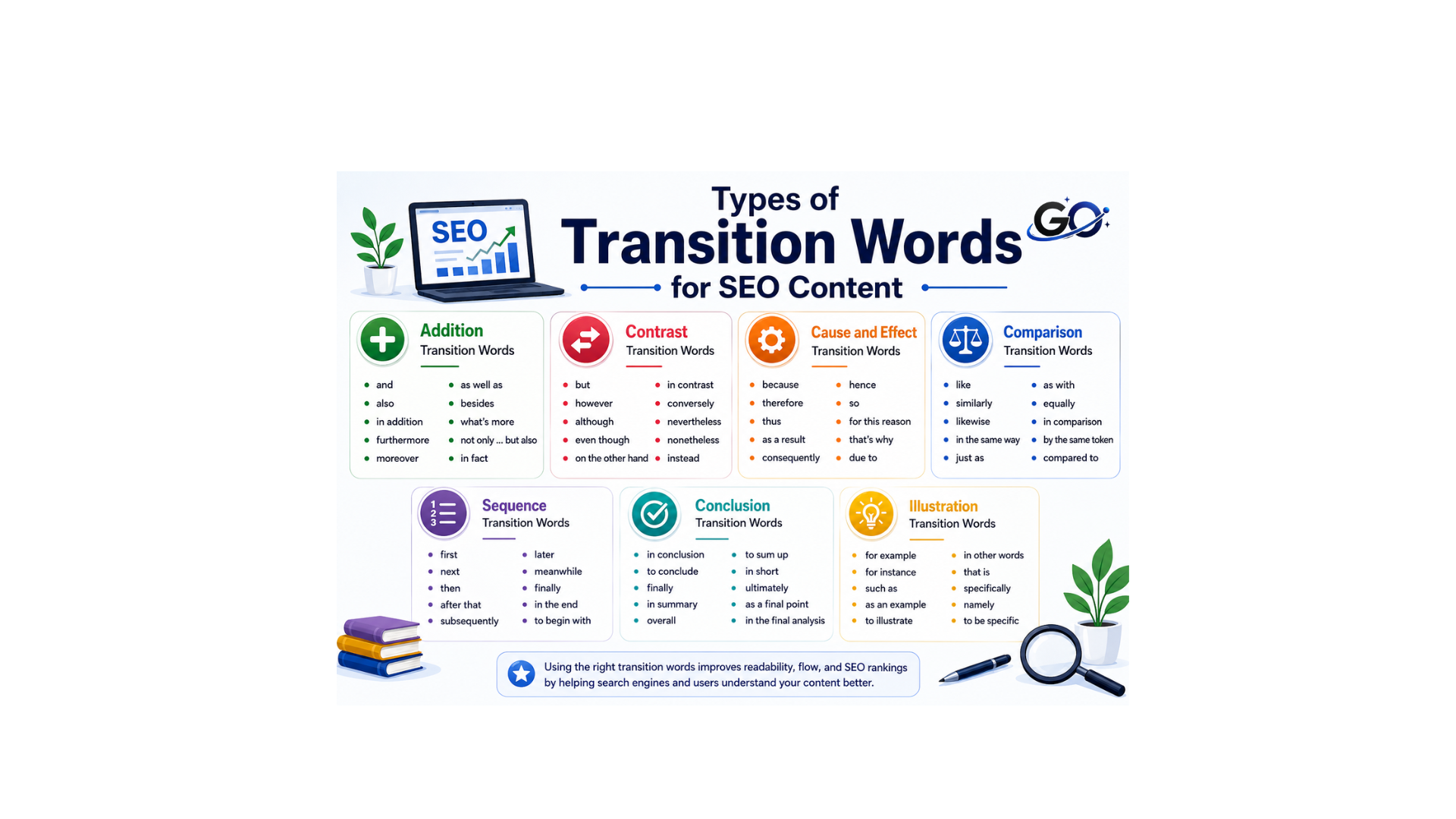
Different transition words communicate different relationships between ideas. Choosing the correct type is more important than simply using a large number of transitions.
Addition Transition Words
Additional transition words, as their name implies, connect two or more phrases and illustrate their relationship.
Another name for these transitional words is enumeration words or phrases.
Other transition words include and, also, furthermore, what’s more, also, and then, first/secondly, and next.
Example:
Keyword research helps identify relevant search terms. Additionally, it can reveal questions that users frequently search for.
These transitions work well when expanding an explanation or adding supporting information.
Contrast Transition Words
Contrast transition words show a difference, disagreement, or opposite idea between two sentences or points. Common examples include however, although, but, nevertheless, on the other hand, in contrast, and while. Using these words naturally improves content flow and makes your writing easier to understand.
Example:
A website may have excellent content. However, slow loading times can create a poor user experience.
The word “however” clearly signals a change in direction.
Cause and Effect Transition Words
When two assertions or events are directly tied to one another, cause and effect transition words are employed. When one assertion is a consequence of another, we employ cause and effect transition words.
Consequently, in light of, in the event of, given that, and hence are examples of cause-and-effect transition words.
Example:
Large images can increase page size. As a result, they may slow down page loading.
Cause-and-effect transitions are particularly useful in technical SEO articles and educational content.
Comparison Transition Words
Comparison transition words are used to show similarities between two ideas, topics, or points. Common examples include similarly, likewise, in the same way, just as, and equally. Using these words helps connect related ideas and makes your content smoother and easier to read.
Example:
Internal links help users navigate a website. Similarly, they help search engine crawlers discover related pages.
Sequence Transition Words
Time transition words, sometimes referred to as sequential transition words, inform the reader of the chronological sequence in which specific events occur. These terms can be used to provide detailed explanations of how objects operate or the procedures needed to finish a certain task.
Example:
First, identify the target keyword. Next, create useful content around the search intent. Finally, optimize the page for readability and technical SEO.
These transitions are especially useful in how-to articles and tutorials.
Conclusion Transition Words
The reader is informed that the paragraph or article is almost finished using concluding or summarising transition words. The most significant concepts or points of debate that the author made throughout the entire text are summed up in these transition words.
Example:
Overall, transition words can make SEO content easier to understand and navigate.
IllustrationTransition Words
The illustration transition is the final transition word. These words serve to provide or provide the reader with an example of the first assertion.
Transitional words for illustrations, such as “to demonstrate,” “to illustrate,” and “on this occasion.”
Example:
I adore preparing Asian cuisine. For instance, I made Lo Mein for my whole family yesterday night, and I had a great time.
How to use transition words
Transition words are useful tools, but they must be employed carefully to enhance the text’s flow. Here are some pointers for doing so:
Avoid overuse: Too many transition words can make your text sound mechanical or forced. Use them sparingly.
Choose the right transition: Choose transitions that accurately reflect the relationship between ideas.Use “Therefore” for cause and effect and “However” for contrast, for instance.
Maintain consistency: Make sure your transitions are consistent in tone and style so that the flow of your text is not interrupted. For example, avoid mixing formal transitions like “moreover” with casual ones like “on top of that” in the same piece.
Change up your transitions: To keep the reader interested and prevent repetition, use a variety of transition words.
Use Transition Words Between Sentences and Paragraphs
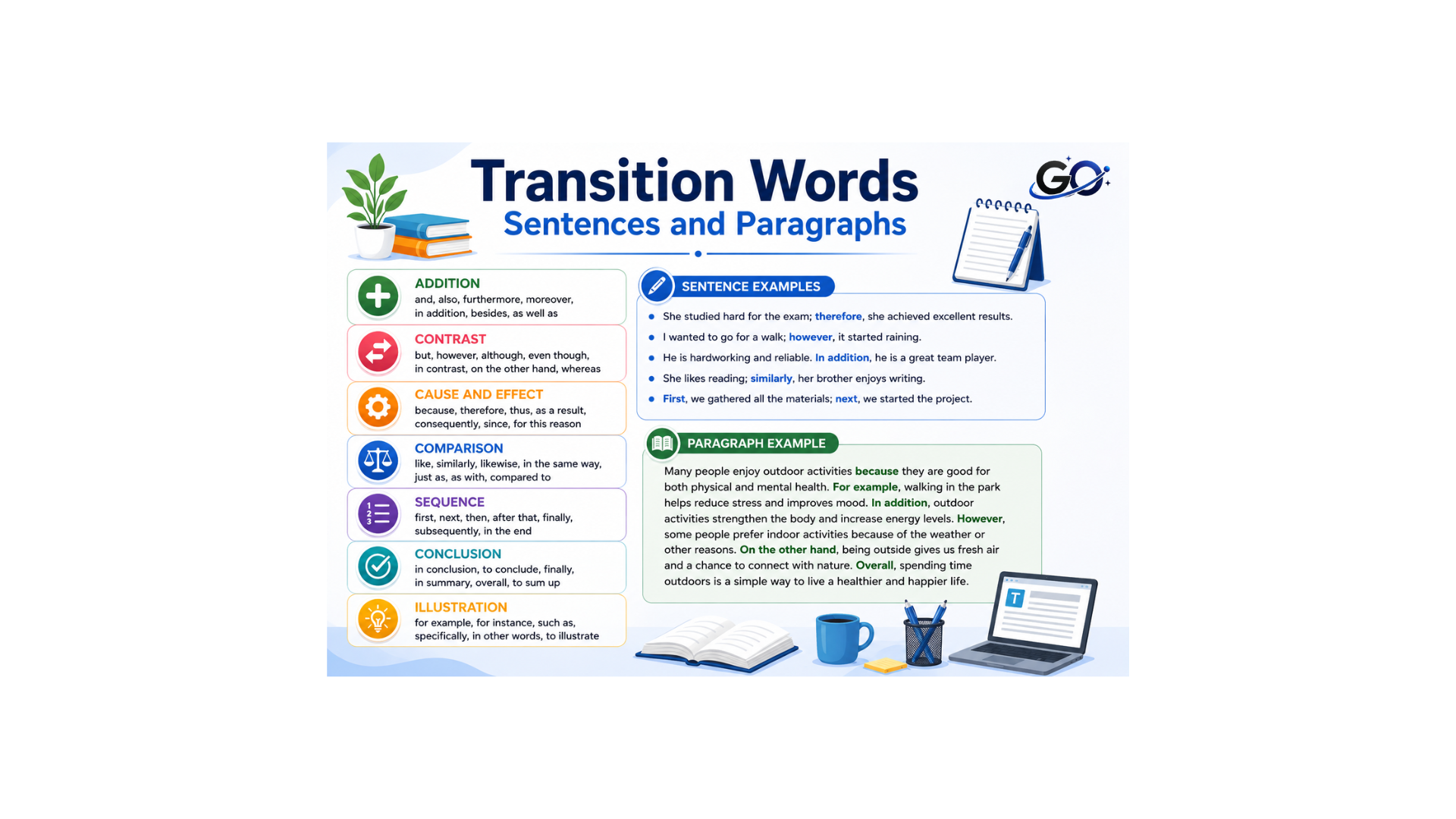
Both individual phrases and longer sections of an article can be connected by transition words. For instance, “therefore” can demonstrate a conclusion based on the preceding sentence, whereas “however” can present a contrast. Phrases like “after that,” “in addition,” or “for example” might assist readers grasp how one topic relates to another in between paragraphs. But when the ideas are already evident, not every sentence or paragraph needs a transition.
Avoid Overusing and Repeating Transition Words
Content that uses too many transition words may sound robotic or repetitious. Words like “however,” “therefore,” “additionally,” and “moreover” should only be employed when they strengthen the link between concepts. Another way to make writing seem artificial is to start each phrase or paragraph with the same transition. When it makes sense, use varied transitions, but never substitute an awkward term for a clear one just to avoid repetition.
Use Transition Words With Clear Sentences
When the sentences themselves are concise and straightforward, transition words function best. Sentences with too many ideas or intricate structures cannot be fixed by them. For instance, break up your points into shorter sentences and use a single appropriate transition when necessary rather than combining multiple points with multiple transitions. Clear sentence structure enhances the readability of your text overall and facilitates understanding of the relationships between topics.
Transition Words in Long-Form SEO Articles
Transitional words can facilitate readers’ seamless movement between sections in long-form SEO articles, which frequently cover multiple related themes. Before discussing search intent, content optimisation, internal linking, and technical SEO, an article can, for instance, address keyword research. Keyword research and search intent can be naturally connected with a sentence like “after identifying relevant keywords.” This helps readers comprehend how various sections relate to one another and establishes a logical flow.
Best Practices for Using Transition Words in SEO Content
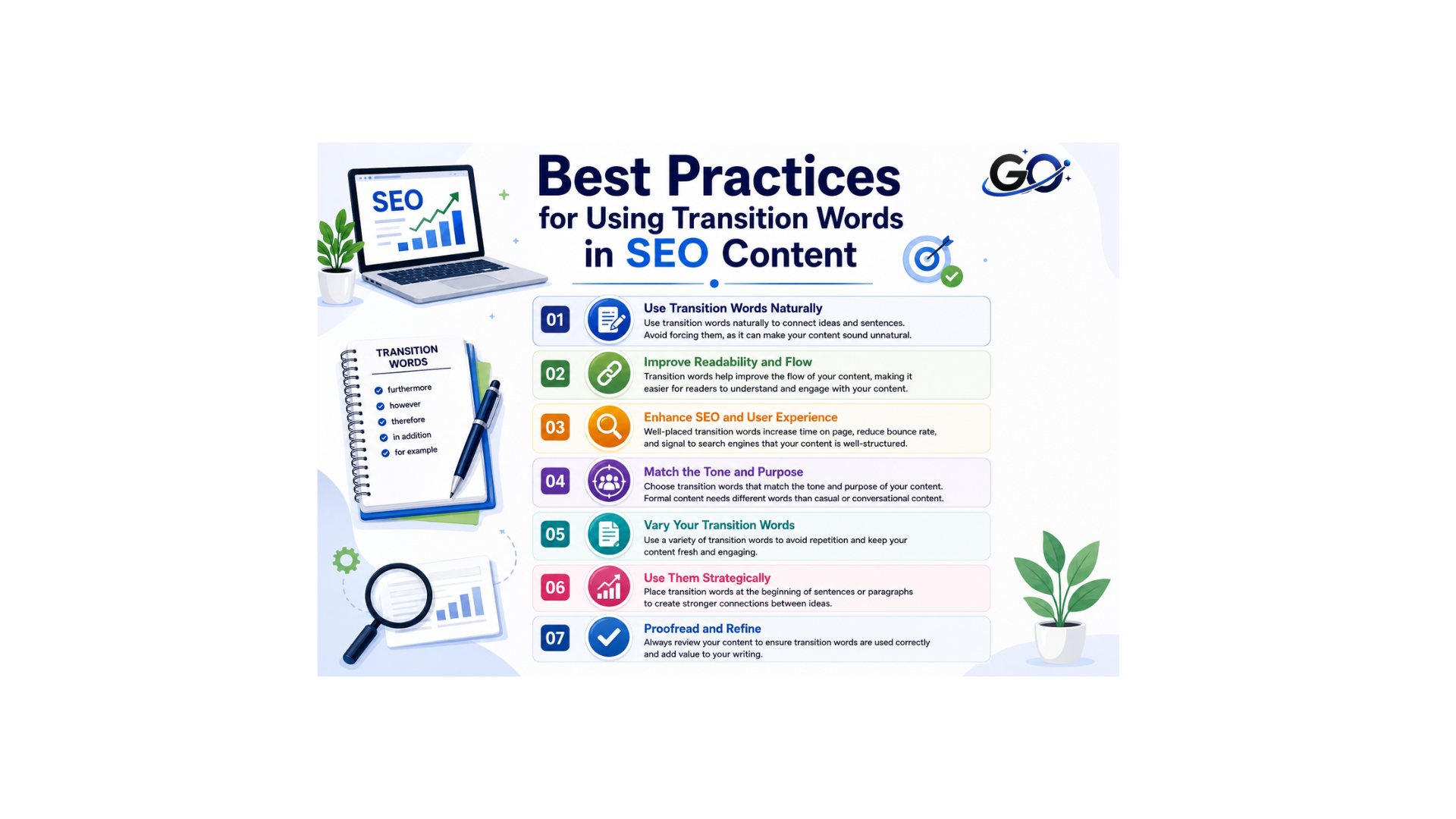
Using SEO transition words in your text will guarantee a high-ranking webpage that is simple for readers to navigate. The following advice will assist you in using SEO transition words into your writing:
Think about how your work is organised and where transition words might be most helpful. This is typically done in the body paragraphs of blog posts when you are trying to support an argument. To draw customers to a product listing or online store, you might use more transition words near the bottom of the listing.
Recognise and comprehend the distinctions between transition words and their distinct meanings. When composing your post, this will assist you in selecting the best transition word.
Only input a transition word when necessary. While their use is important, they should not be forced into the website copy for the sake of it. Saturating your writing with too many transition words can make it harder to read for both humans and search engine algorithms.
Conclusion
Transition words are useful for creating smooth, logical, and readable SEO content. They help readers understand how sentences and paragraphs are connected by showing relationships such as addition, contrast, cause and effect, comparison, examples, and sequence.
Although transition words are not a direct ranking factor, they can support readability and make long-form content easier to understand. The key is to use them naturally rather than adding them simply to satisfy an SEO or readability tool.