

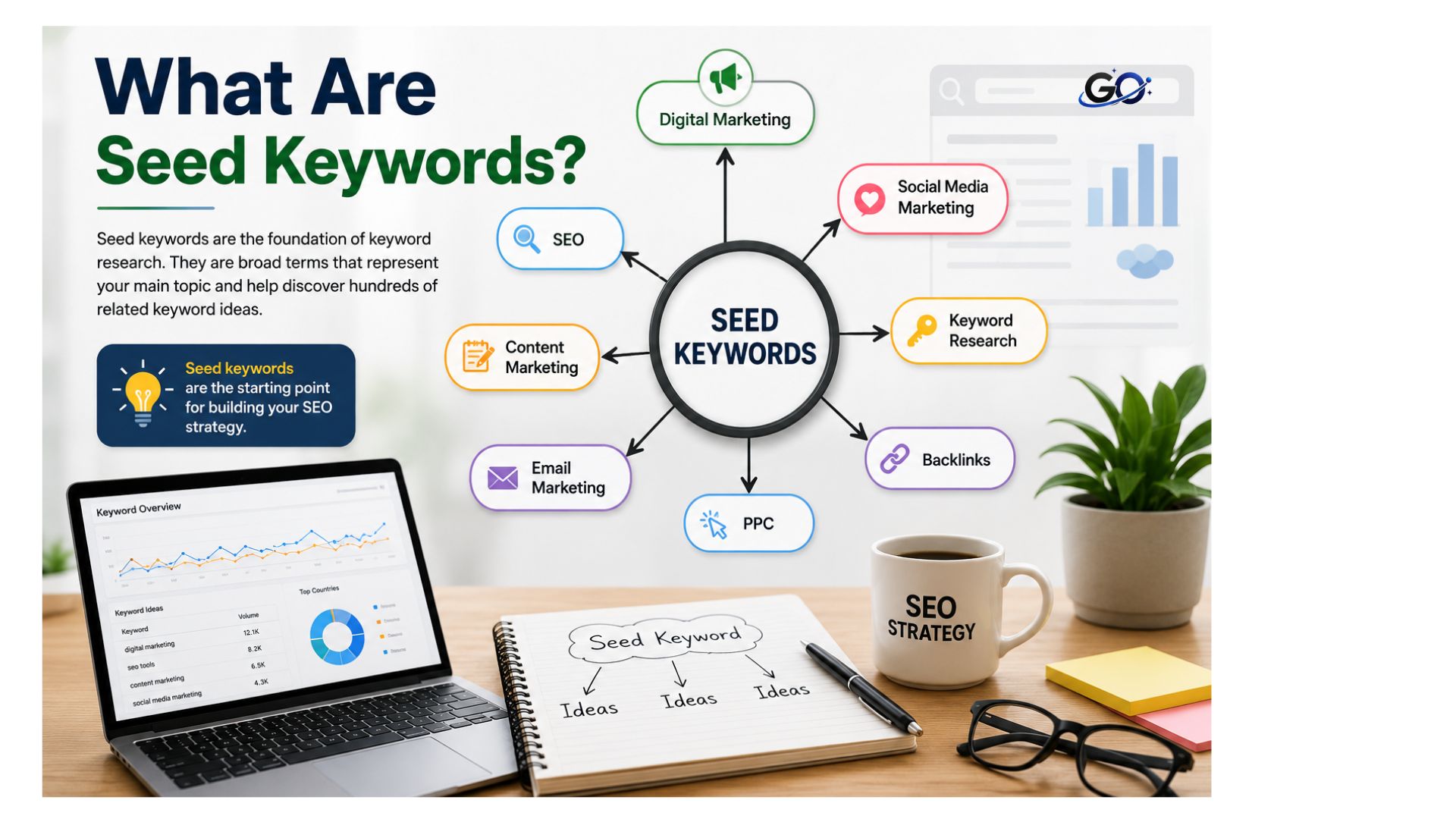
A seed keyword is a short, broad term that serves as the starting point for keyword research. These are typically one or two words long and describe a topic at its highest level.
Every successful SEO strategy begins with keyword research. Before you can find profitable keywords, create optimized content, or rank on search engines, you need to identify the foundation of your keyword strategy.
These foundational terms are known as seed keywords.
These basic words and phrases describe your business, niche, product, service, or content topic. They are sometimes called head terms because they sit at the top of a keyword hierarchy because they sit at the top of a keyword hierarchy. From a single seed, you can generate dozens or even hundreds of more specific keyword variations.
Understanding the Concept of Seed Keywords
Seed keywords are broad search terms that define the main topics of your website. They usually consist of one to three words and represent the general subject area you want to target.
Think of seed keywords as the roots of your SEO strategy. From these roots, many keyword variations grow. When entered into keyword research tools, seed keywords generate hundreds or even thousands of related search terms.
For example, the seed keyword “SEO” can produce keyword ideas such as:
- What is SEO
- SEO tools
- SEO audit
- SEO checklist
- SEO strategies
- Technical SEO
- Local SEO
- SEO for beginners
Each of these keywords can become a separate article or content piece, helping your website cover a topic in depth.
Why Are Seed Keywords Important?
Seed keywords are important for keyword research because they’re the basis for medium- and long-tail keywords.
Long-tail keywords are used to optimize subpages. Those subpages are linked internally to other pages like pillar pages, the homepage, or product pages. And help them rank for seed keywords.
They help you identify new opportunities, discover user interests, and organize your content strategy.
They help generate hundreds of keyword ideas from a single term. They help you understand user search behavior and search intent.
Because of these benefits, these foundational keywords remain one of the most important elements of modern SEO.”
Examples of Seed Keywords in Different Industries
Every niche has its own set of seed keywords.
For a digital marketing website, seed keywords may include SEO, PPC, content marketing, social media marketing, and email marketing.
For a health website, seed keywords may include nutrition, fitness, weight loss, healthy diet, and exercise.
For an e-commerce store selling electronics, seed keywords might include smartphones, laptops, headphones, tablets, and smartwatches.
For a travel blog, common seed keywords include hotels, travel tips, flights, tourism, and vacation planning.
These broad keywords can be expanded into many specific search terms that attract targeted traffic.
How to Find Seed Keywords

Finding seed keywords is easier than many beginners think.
The first step is understanding your business or niche. Ask yourself what products, services, or topics your website focuses on. The answers often reveal your primary seed keywords.
Another effective method is to think like your audience. Consider what users would search for when looking for information related to your business.
Competitor analysis is also a valuable strategy. Reviewing competitor websites can help you identify important topics and keywords that are already performing well in your industry.
Google search suggestions provide another excellent source of seed keywords. Simply type a broad term into Google and observe the autocomplete suggestions that appear.
Keyword research tools can further expand your list and provide data about search volume, competition, and trends.
Seed Keywords and Search Intent
Search intent refers to the reason behind a user’s search query.
Understanding search intent is important when selecting seed keywords because not all searches have the same purpose.
Some users are looking for information, while others want to buy a product or compare different options.
For example, the seed keyword “laptop” can lead to various search intents:
Someone searching for “best laptops for students” wants recommendations.
Someone searching for “buy gaming laptop online” has purchase intent.
Someone searching for “how does a laptop work” is looking for information.
Understanding these differences helps you create content that matches user expectations.
Seed Keywords vs Long-Tail Keywords
One of the most common questions around seed keywords is how they differ from long-tail keywords. The distinction matters because it shapes how you approach your content strategy.
Seed keywords are broad, typically one or two words, and carry high search volume with intense competition. Long-tail keywords are more specific phrases of three or more words with lower volume but also lower difficulty. They express clearer search intent, which means visitors who find you through long-tail queries are often closer to taking action.
Here is a simple comparison:
- Seed keyword: “email marketing” (high volume, high competition, broad intent)
- Long-tail keyword: “best email marketing tools for small business” (lower volume, lower competition, specific intent)
You should not treat these as an either-or choice. Seed keywords give you the map. Long-tail keywords are the individual routes you take to build traffic. Start by identifying your seed keywords, then expand each one into a cluster of long-tail variations you can realistically rank for.
Additional tools to discover seed keywords
Seed keywords are everywhere. You often have to get creative to find them, but the better your initial seed keyword list, the better your final keyword strategy will be.
1. Google related searches
Search any keyword phrase, scroll to the bottom, and Google will show you a list of related keyword phrases.
We also recommend this nifty Chrome extension to extract even more Google related searches.
2. Ahrefs
Ahrefs is one of the most popular SEO tools used for keyword research, backlink analysis, and competitor tracking. It helps website owners find valuable keyword opportunities, analyze competitors’ strategies, and improve their search engine rankings through data-driven insights.
3. People also ask
While these tend to be a bit more specific, you can also harvest seed keyword ideas from Google’s “People also ask” boxes.
4. Google Keyword Planner
Google’s own keyword planner tool for its profitable Adwords platform provides a wealth of keyword ideas.
One caveat: many of the metrics are geared towards paid search ads, and not extremely reliable for organic campaigns.
5. Uber suggest
Ubersuggest is a user-friendly SEO tool that helps marketers discover keyword ideas, analyze search volume, and track website performance. It is especially useful for finding low-competition keywords and generating content ideas to improve organic traffic.
6. Answer the Public
The always popular Answer the Public is a favorite starting point for many keyword research projects. The free plan is so generous, we had to include it here.
7. Google Trends
Google Trends is another Google tool that provides interesting insights and related queries for any keyword, it will even show you historic keyword data and break interest down by geographic region.
Forums and Online Communities
Find out which forums and websites your target audience congregates in. These can be a goldmine of information you won’t find in the SERPs or anywhere else. And what better way to get it, than from your audiences themselves?
Browse Facebook Groups, Reddit or Quora to start with, and then delve deeper into your niche-focussed communities. For example, it’s a no-brainer that the SEO community on Reddit is important to us for the same reason. There are several discussions around keyword optimization and Surfer’s tools.
Common Mistakes to Avoid
Many beginners make mistakes when choosing seed keywords.
One common mistake is selecting keywords that are too broad. Highly competitive terms can be difficult to rank for, especially for new websites.
Another mistake is ignoring user intent. A keyword may have high search volume but may not match your audience’s needs.
Some website owners focus only on search volume and ignore keyword relevance. Traffic is valuable only when it comes from the right audience.
Using unrelated keywords can also damage your SEO efforts by attracting visitors who are not interested in your content.
Avoiding these mistakes will help you build a more effective keyword strategy.
Analyze Competitors’ Keywords
The last way to find seed keywords is to extract competitor keywords.
To get the most value from seed keywords, start with a list of broad terms related to your niche. Use keyword research tools to expand these terms into more specific keyword opportunities.
Focus on relevance rather than search volume alone. Choose keywords that align with your audience’s interests and business goals.
Regularly update your keyword research because search trends and user behavior can change over time.
You’ll use the same tool you used in our last section (the Extract tool), but instead of entering your domain, you’ll enter your competitor’s websites. You can also include multiple competitors at once.
Conclusion
Seed keywords are the foundation of successful keyword research and SEO. They represent the core topics of your website and help generate countless keyword opportunities for content creation and optimization. By understanding what seed keywords are and how they work, you can build a stronger SEO strategy, improve search visibility, and attract more targeted traffic.
Whether you are launching a new website or improving an existing one, seed keywords should always be the starting point of your SEO efforts. With the right seed keywords, you can discover valuable content ideas, understand your audience better, and create content that ranks higher in search engine results.